If you would like to request an exhibition catalogue, please email: cedric@cedricbardawil.com
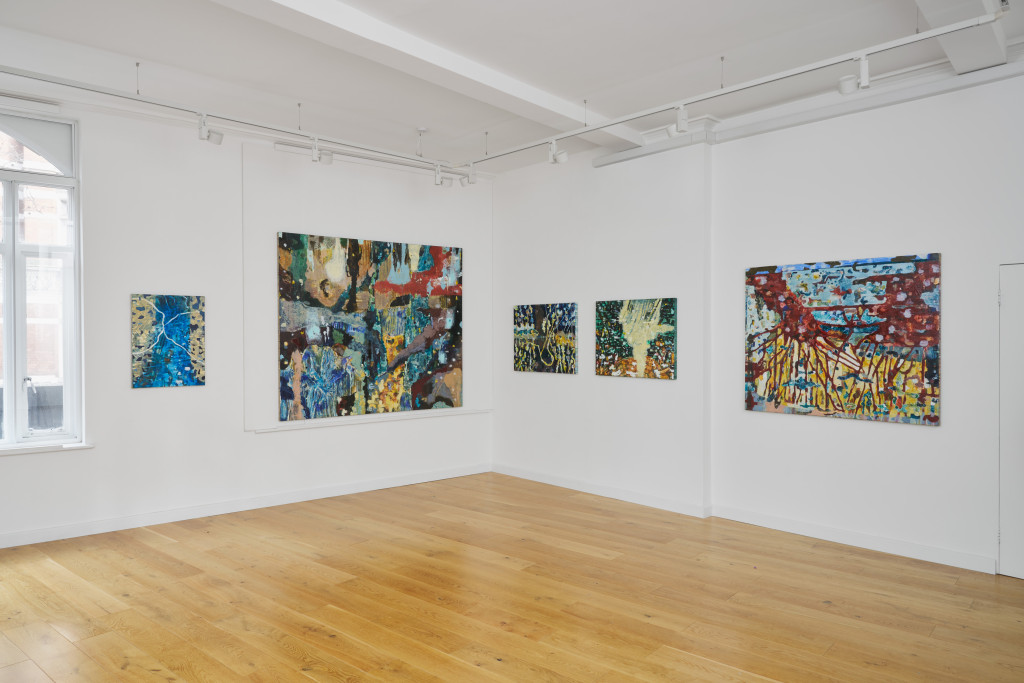
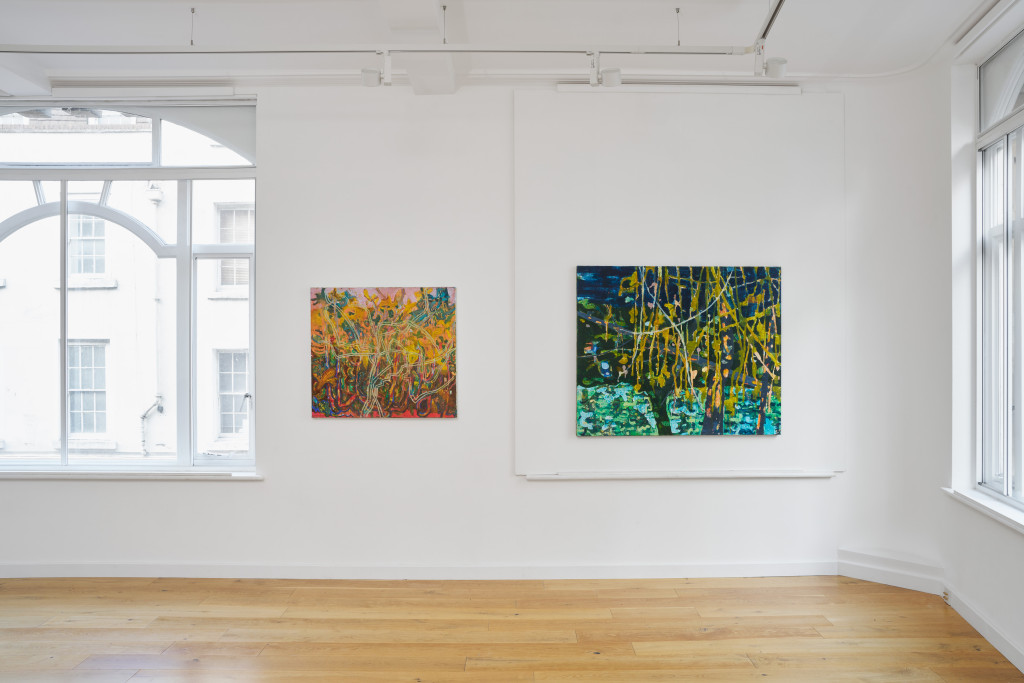
For her second solo exhibition at the gallery, Ella Wright presents a body of new paintings which find imaginative potential in the otherwise overlooked. Informed by direct observations, fragments of found photographs and dissected film stills, the works act as fractured reflections of her immediate surroundings. Wright zooms in: small zones of ‘unwanted’ growth, branches knotted in power cables, fluorescent light in suburban rivers, moss, lichen and textures in rock and mineral. Through her process of painting, this slippery, vegetal matter becomes abstracted, inviting us to see afresh, as new, unexpected images are revealed.
Ella Wright – Still Moving
Essay by Rebecca Birrell
Sunlight that glares, bathes, half-conceals. A furtive, lustreless moon. The sky clouded over; violet and blue tints in the clouds. A warm and rustling wind; a wind that tugs at wild grasses. Plumes of blossom, or delicate sprays of blossom, which glow even in the shade. Foliage drenched in a fragrance so powerful it becomes visible as foam. The ornamentation of leaves; petals like white satin. Glittering stamens, their throats blushed pink, arranged in melodic, rhythmic patterns. These are all paraphrased fragments from early in Marcel Proust’s novel, In Search of Lost Time, but they could easily be transcriptions of paintings from Ella Wright’s new presentation, Still Moving. Proust produces dense, digressive descriptions of the natural world enriched with sensual pleasure. Wright’s paintings, which flicker between abstraction and figuration, are similarly interested in how to reproduce attention to a landscape. Proust’s young narrator walks the same paths around his family home and finds ways to re-encounter these surroundings with an intensity and freshness that continually yields luscious, lyrical visual information. Wright shares Proust’s preoccupations, and even uses his preferred method for slow-looking: walking. Wright manoeuvres through her landscapes guided by a way of seeing inclusive of memory, emotion, tactile detail, and a catalogue of extraneous cultural sources.
An upsurge of weeds in an industrial estate, the basis of Traces, appears diminutive glimpsed from a distance, and expands on approach, both in size and in detail, becoming glossily, thickly textured and variegated in colour. Wright’s mobile vantage point and intimate scale somehow captures the essence, arc and duration of this ordinary transformation. A multitude of perceptions are condensed into a single image, but each impression retains its character and aliveness. These paintings are dense in the way a Proustian sentence is dense: they teem with subjectivity, and they are palimpsests of vivid sensory experiences. Density, in these paintings, is partly about conveying the depth and complexity of perception, its peculiarities and restlessness. Sight is as pertinent here as touch, and everywhere in these paintings there is a pleasure in the medium’s texture and materiality. Density is a surfeit of texture, and it begs the question of what lies beneath: it invites excavation.
Wright has carved into the canvas, as though curious herself, leaving thick rivulets within the painted surface. This technique inscribes sweeping lines redolent of an aerial view of the same landscape, a topographical map marking paths for walkers and the course of a river. The result is a comprehensive sense of the raw visual data Wright collected in assembling the painting. The other effect is phenomenological: Wright conveys something of the physical act of looking, its force rather than its delicacy, which can be so automatically invoked in landscape painting in the Post-Impressionist tradition.
What we might infer from Wright’s almost sculptural interaction with paint — its layering and erasure that suggest three-dimensional space — is that perception does not issue from a static, disembodied eye, but is rather a form of interpretation reliant upon a range of physical senses and neurological phenomena. Judgement, desire, memory, energy and attention all shape what we see and how we choose to record it. Wright’s interweaving of found images into her paintings (from photography and film, amongst other resources) only strengthens this argument.
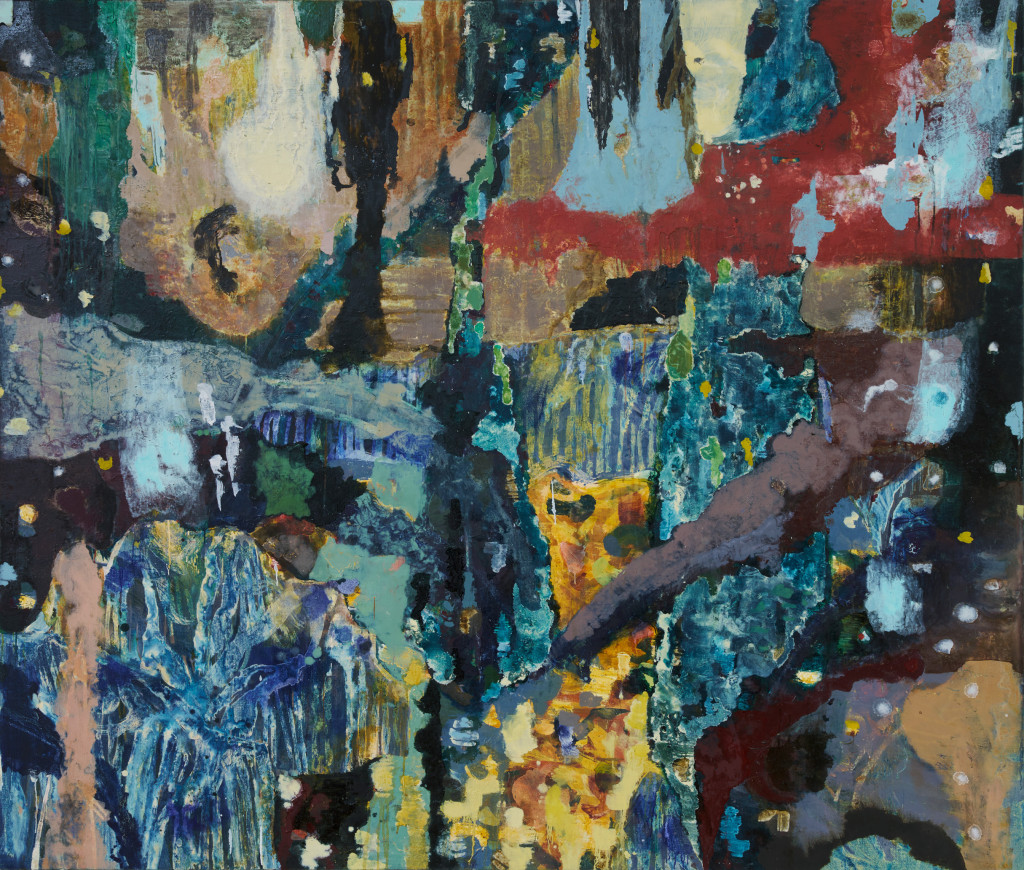
In After Image, Wright extends this association between sight and interpretation. What began as a more figuratively descriptive painting, Wright tells me, evolved into a work concerned with using the materiality of paint as a substitute for traditional figuration. A shimmering, craggy blue mass sits in the lower left quadrant of the painting. A depiction of a rock blanketed in moss became an abstract form expressive of the quiddity of a rock, the feel of plants and fungi growing out of damp and dimness. Abstraction frees Wright from her original point of reference, and other images from the natural world emerge. A choppy stream, icicles, the hanging branches of a weeping willow. Yet no single vision sticks: they appear as though reflected on water — fleetingly, dissolving and reforming. Light, depth and mass are deliberately confused, and there is little sense of whether forms are hard or soft, wet or dry, shadow or thing, flowing or motionless. All of Wright’s paintings exhibit this apposition of multiple views, rhythms, and light sources. Ambiguity prevails.
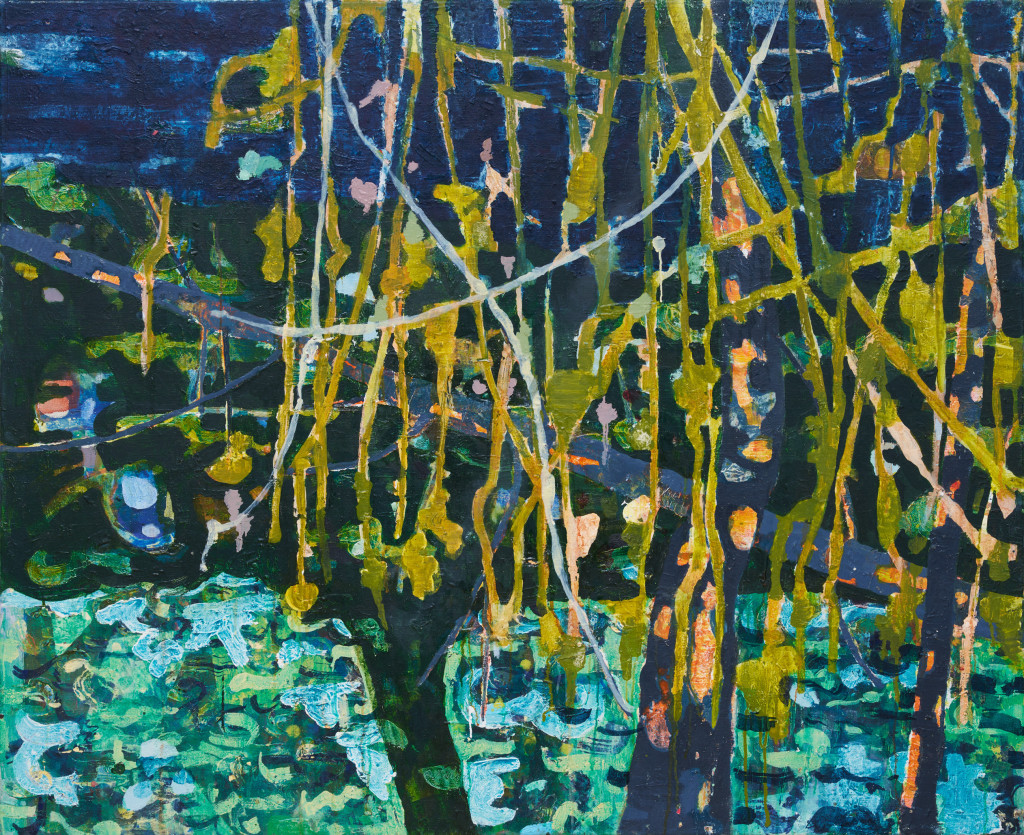
The flattened perspective that gives a number of these paintings their elusive, coruscating decorative surface, alludes to both the tradition of ukiyo-e artists and the twentieth century European artistic movements that used Japanese print-making to reinvigorate their compositional styles. This serves to remind us that perception is heavily circumscribed (especially for artists, if not for all of us) by art historical ways of seeing. Wright embraces this condition of inevitable visual intertextuality through reusing and recycling the modes of her predecessors. Motifs from ukiyo-e find new expression, chiefly in After Image and Drift. Here is a rainy evening, with threads of streetlight glinting from puddles on the ground, the shadows having acquired an uncanny, autonomous presence. The play of light in Drift casts blossoms onto shallow pools of water (or deeper currents through which flowers and their reflections might drift), sheltered by calligraphic tree branches.
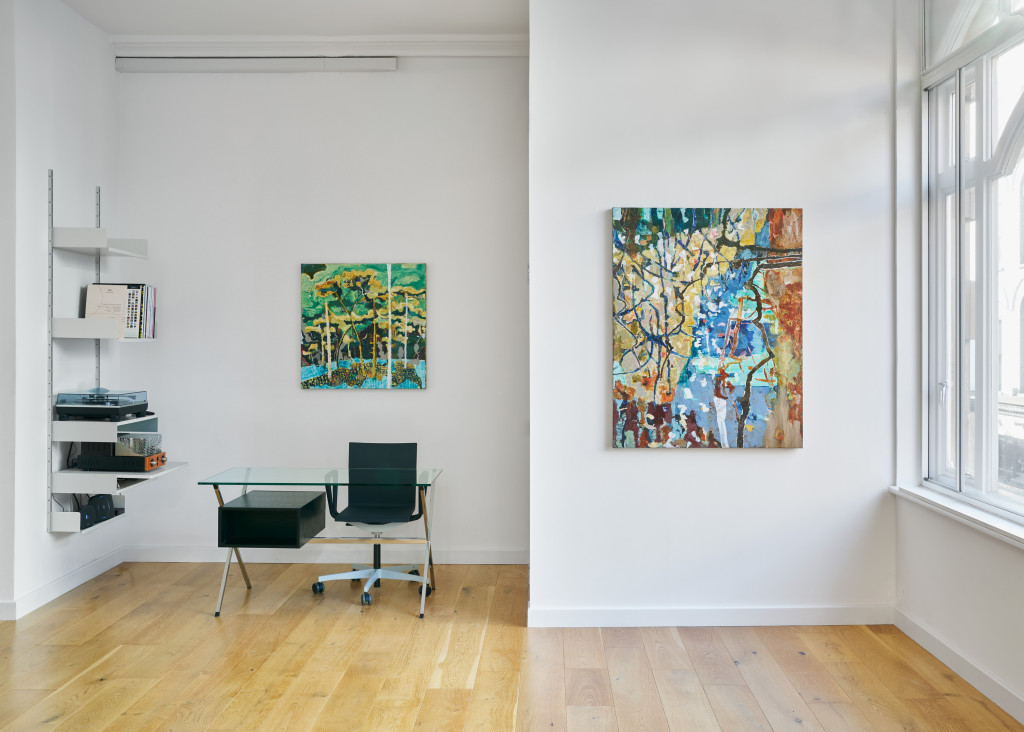
The title of After Image refers to optical phenomena, and it is not the only painting amongst this group to reference the physiological aspects of vision. Double could be split down its middle to reveal an uneven, wavering mirror image, and imitates the effects of double vision. Perceptual distortions and confounding reflections also characterise Street and Night Shoot. In Tumble, the branches of a tree appear to flower with reflected light, and the blurred forms beneath arise as though from an eye squinting against the sun. In Clearing, light ripples and clots over what appears to be a wooded area in a fusing of different scales, vantage points and fields of vision that draws attention to the mechanisms of sight. Associations are made in several paintings between the eye and the camera lens, which operate in analogous ways. The green patina of Night Shoot responds to, Wright explains, the colour of street light in film from the 1970s — a combined result of mercury vapour bulbs and the film stock of the time. The colour reappears, slightly altered, with an echo of this cinematic association, in Street, Still Light and Crossing. Crossing develops this exploration of light out from the human visual system (and technologies designed to mimic it) to the optical effects and processes of a wide variety of organisms. This painting was born out of Wright’s interest in bioluminescence. The luminous greens and yellows of Crossing bring to mind creatures and algae capable of radiating light, most of which reside in the sea. Crossing allows the viewer to occupy both a conventional vantage point, gazing upright out a window onto scenery, and a horizontal, underwater stance, as though snorkelling through a patch of bio-diverse ocean.
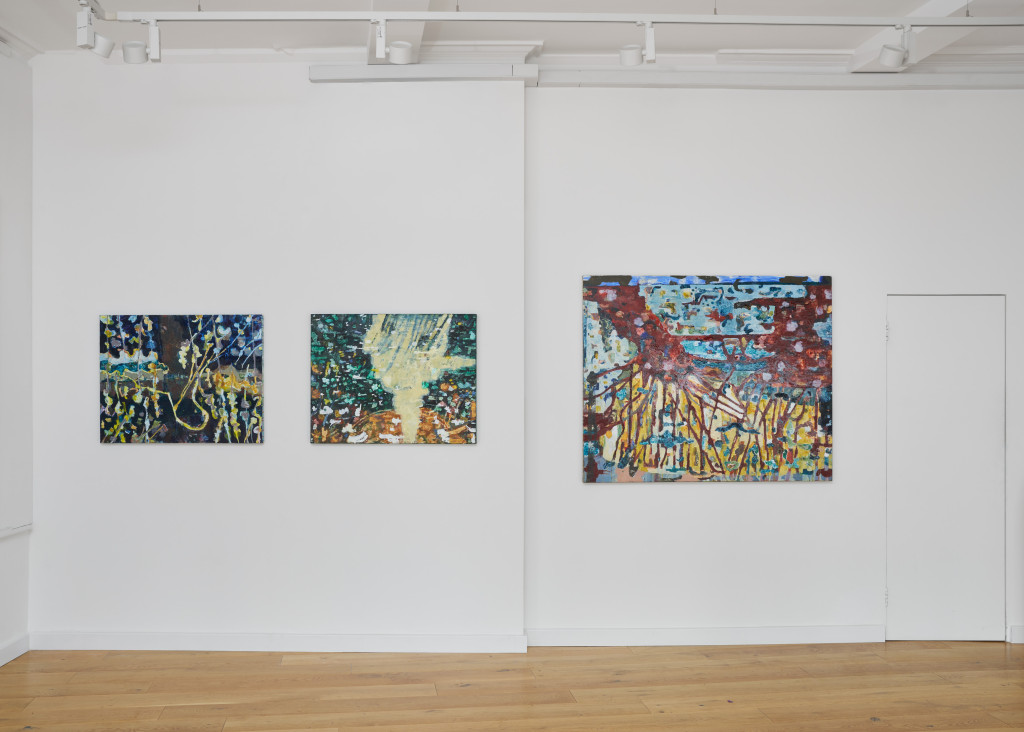
Network demonstrates Wright’s non-hierarchical treatment of landscapes and cityscapes. The urban is not a degradation of a pastoral ideal, nor is the natural a harmonious realm bound to be polluted by human contact. The crosshatch of lines that dominates Network were taken from drawings Wright made during a trip to Mexico City, where the space between street and sky is filled with cables and wires. However, the deep red of the arboreal forms in Network recall bark, clay and blood rather than electrical wiring, and with these associations Wright foregrounds connectivity and growth in the sprawl of the city’s architecture and infrastructure. Network sees something organic — and ultimately beautiful — in this trace of how humans use and traverse the city.
Colour is used with an experimental dint across Wright’s body of work. The traditional palette of landscape painting is abandoned. There are few of those subdued greens and browns, and no subtle blues marking the horizon. Looking at After Image and Street, the colour that pervades is rather a bright, artificial blue, a hue that’s rare in nature. This certainly isn’t the blue of the sky or of water: it has neither the radiance of the former or the fluidity of the latter. Wright’s blue is astringent, synthetic, slightly alien. The same can be said of the heightened orange in Traces, and the lurid sea-foam quality of the turquoise in Tumble and Drift. Experiments with tone are just one part of Wright’s effort to reveal the beauty of nature as strange, and ultimately more explosive, capable of imprinting on our consciousness more permanently.
Proust describes the same flowers, trees and vistas repeatedly, and eventually the reader amasses so many of these descriptions that the most common plant feels multitudinous, rich with potential. Wright achieves her own set of open-ended transformations. Still Moving, the title of the presentation, announces this intention, but you have to see these paintings – to see as they encourage us to see, to see with and through them – to fully appreciate why this expansive, surprising way of seeing is so exciting.