If you would like to request an exhibition catalogue please email: cedric@cedricbardawil.com
The 6 o’clock in Siena is a solo exhibition of new work by Isabelle Young (b. 1989).
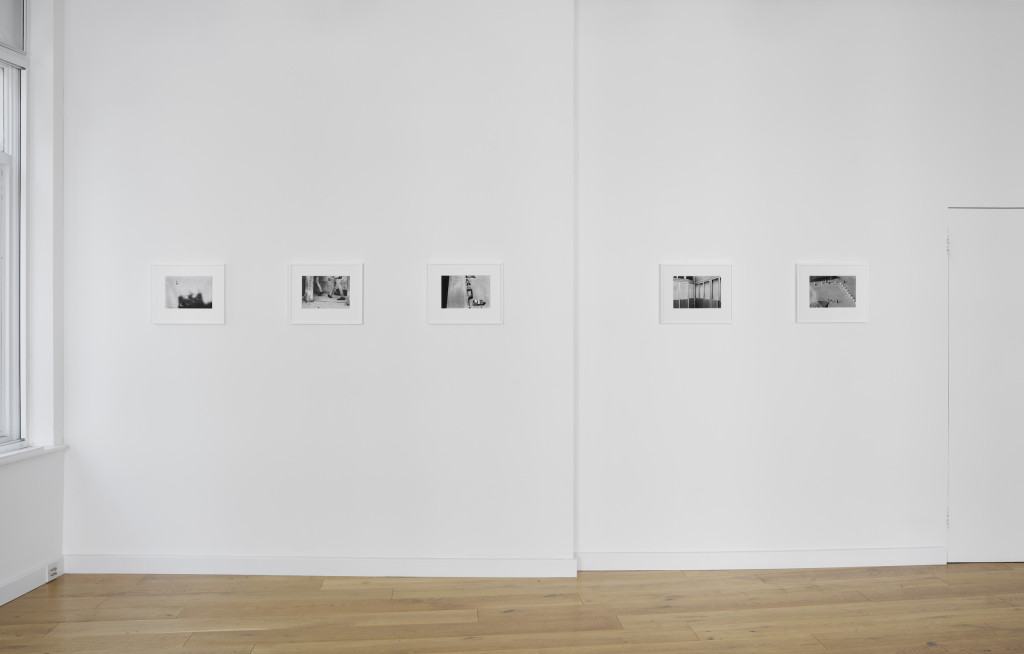
Young’s photographs of the Palio di Siena capture Italy’s most extraordinary horse racing event, famous for its skulduggery as much as its medieval pageantry, in its overlooked moments of quiet and shadow. An incisive observer of casual and accidental intimacies in public spaces, and drawing on the documentary and monochrome traditions of Henri Cartier-Bresson and Eugène Atget, Young’s photographs offer a route forward for contemporary photography by looking to the past.
Midway upon the journey of our life
I found myself in a dark wilderness,
for I had wandered from the straight and true.
– Dante, Canto I, ‘Inferno’, The Divine Comedy (1472), translated by Elio Zappulla
Siena, July. Imagine the scene. Handsome young men in yellow and red tunics beat drums that are affixed to their medieval belts, announcing the start of the Corteo Storico, a pageant to the sound of the March of the Palio. Forest green flags depicting a goose wearing a crown and a little white cross with blue tassels are unfurled: the Contrada dell’Oca, one of 17 rivalrous contrade, announce their presence to the crowds who have gathered in their thousands, many with their generations-old loyalties and some with none. Young girls huddle in groups on the outskirts of the action before suddenly breaking off into several directions at once, like dispersed prey, to entertain their mischief elsewhere. Members of the Contrada del Nicchio, with their blue flags of shells and stars, career past with vengeance in their eyes. A gentle boy whispers into a horse’s ear. Then, as though summoned by history itself, ten riders on ten horses go hell for leather around the Piazza del Campo to win a banner of painted silk. This scene is the Palio di Siena, Italy’s oldest horse race held twice each year, on 2 July and 16 August, celebrated on the day of the Assumption of the Blessed Virgin Mary, the Sienese patron saint.
“The centrifugal-like energy of the city reminded me of Dante’s inferno – swirling masses of different groups, singing, beating drums, waving flags”, reflected British photographer Isabelle Young after witnessing the Palio on a blisteringly hot Sunday afternoon: “The energy of entire days were defined by events in the campo; they continuously built to a crescendo then crashed with an abrupt exodus of contradaioli (members of Siena’s districts) the second they ended.” Young, whose grandmother was Sicilian but moved to Turin before settling in England in 1948, has been photographing the country’s northern regions for several years. Drawing on, in her own words, “classical details; modernity; industrial Italy and upright stones”, Young has developed a compelling and idiomatic photographic practice that observes the country with an outsider’s fascination and an insider’s intuition. She was returning home to a place she never lived.
Young’s compositional mastery of the shade and shadow, those pockets of ground and wall which we are often encouraged to overlook in favour for what is illuminated and bright, is partly inspired by English poetry and the lyrical patterning of verse which so often inverts a reader’s expectations. Midway through her time in Siena and struggling with the Italian heat, Young thought of the scene in Shakespeare’s Hamlet when the title character is interrogated by his uncle Claudius, the murderer of his father and now husband of his mother, who asks his nephew why ‘the clouds still hang’ on him, to which the Dane replies, often played as bristling with venom: ‘Not so, my lord; I am too much in the sun.’ Too much in the sun. Our protagonist is too exposed, his secrets and his anguish out in the open for all to see. One might say that the Palio is similarly too much in the sun, literally and figuratively; once out on the campo, there is no place to hide. In summer 2024, Young took up a residency in Tuscany and it was during this time that she took the photographs that make up the present collection. While in Italy, she grew closer to England (as when, in England, she longs for Italy), and returned to Philip Larkin’s most celebrated work, The Whitsun Weddings, a poem which tracks, when compared with Florence to Siena, the marginally less glamorous journey on a stopping-train from Paragon station in Kingston upon Hull to the baking heat of Whit on a Saturday afternoon:
Each station that we stopped at: sun destroys
The interest of what’s happening in the shade,
And down the long cool platforms whoops and skirls
I took for porters larking with the mails,
And went on reading.
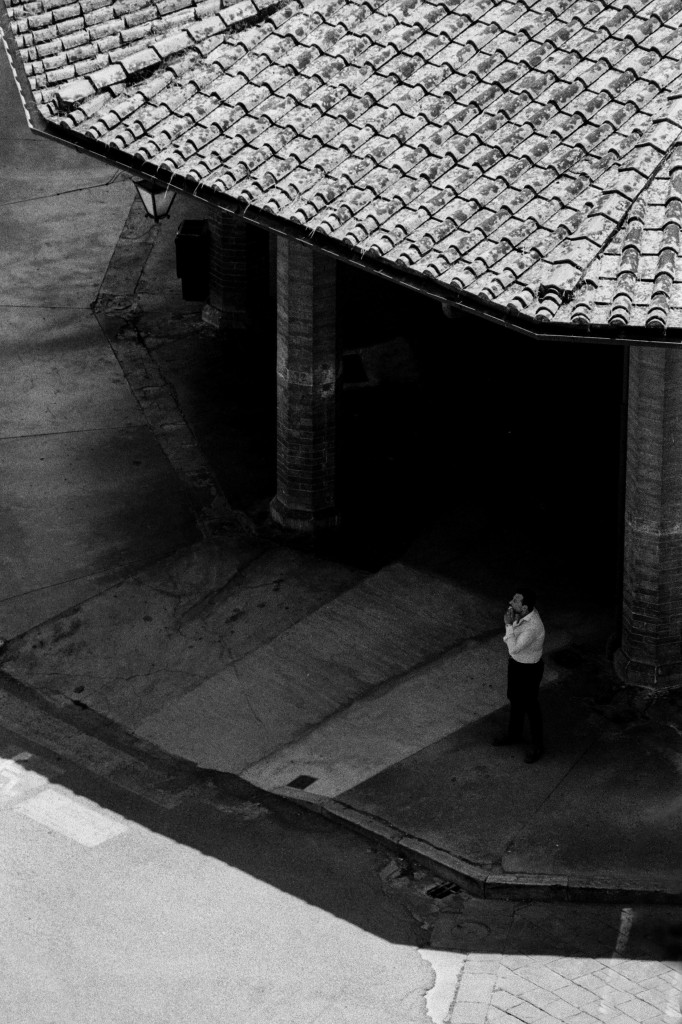
The sun destroys the interest of what’s happening in the shade. Not so for Young. It is intriguing how often her eye is called to those moments of activity in those islands of near-black, a necessity for any photographer on a summer’s afternoon in Siena when the shade is a source of solace and reprieve from the heat. Far from a secondary site of absence, it is the canopy under which so many of the most important things take place. Look at Il Torre (all works 2024), for instance: protected by the shade cast by the tower, a group of well-dressed chancers and revellers scheme while a woman stands, exposed and alone in the hot sun. Young captures the violent juxtapositions of light and dark, providing her scenes with a theatricality befitting the spectacle of the Palio. After years working in colour photography, documenting the church marble, corners, cubbyholes, cafés, and columns of northern Italy and especially Venice in all their vivid hues, Young returned to the monochrome format of her teenage years for this series. In part, this was inspired by the work of Eugène Atget, that most persistent observer of architectures of absence and urban quiet. It is often said of Atget’s photographs that they resemble crime scenes: something has happened, perhaps something terrible like a murder in cold blood, but the street is now deserted. The body has been carted off. The cobblestones have been cleaned of blood. Young’s pictures do not carry over Atget’s melancholic treatment of atmosphere, but you do get the impression that a whole array of dirty deeds, illicit deals and clandestine meetings have just taken place. They probably have. But we see only the quiet which surrounds action like air.
The Palio di Siena is notorious for its skullduggery and the underhand machinations of its players. Ten of the seventeen districts (contrade) are placed into a draw to be designated a horse, which is itself a spectacle of chance, luck, and (almost certain) corruption played out in front of the main square, Piazza del Campo. The secret negotiations, briberies, and betrayals simmer for months. If certain conditions are met, one district might offer to ‘take care’ of a contrade rival’s horse for a fee, which has sometimes meant drugging a mount, or else kidnapping the most talented riders from the surrounding region. Allegedly, only sabotaging a horse’s reins remains beyond the pale. Jockeys whip their horses, and each other, with crops made from cured distended bull’s penises. Even the word for ‘jockey’ (fantino) has come to mean ‘untrustworthy’ in this part of Tuscany. Whether by deceit or the intrinsic danger of racing horses at full speed in such closed quarters, falls and collisions are inevitable: in a third of races over the past 72 years, half of all jockeys (who ride bareback) have been flung from their steeds. On average, one horse a year dies. The lore of deceit and danger which surrounds the Palio transform the meanings of Young’s pictures, speaking to the dirt and the history and the secrecy of the event.
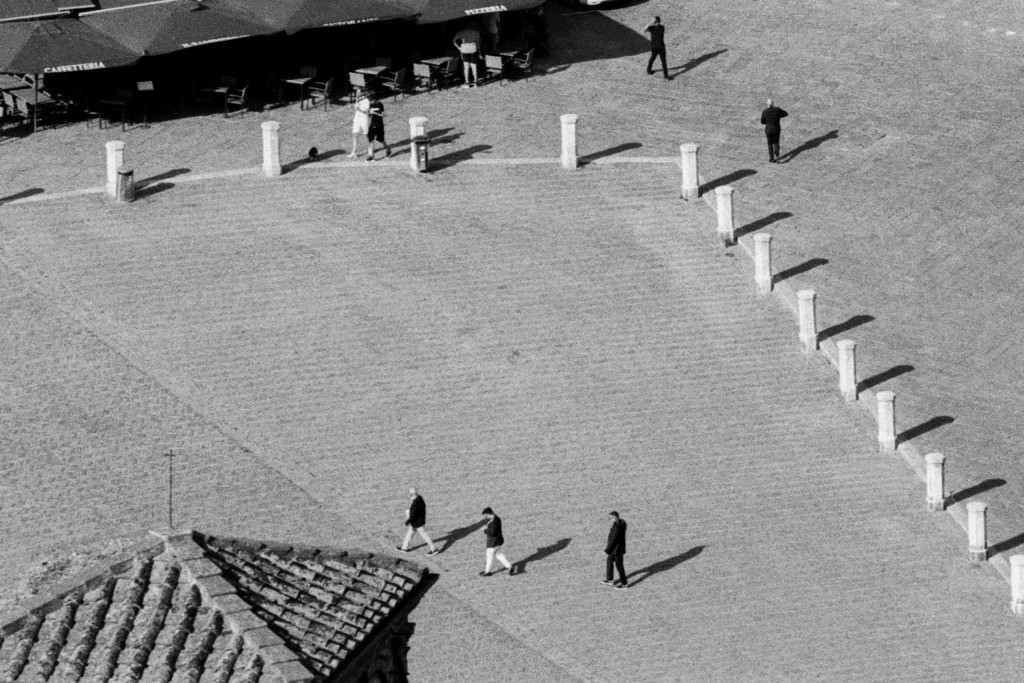
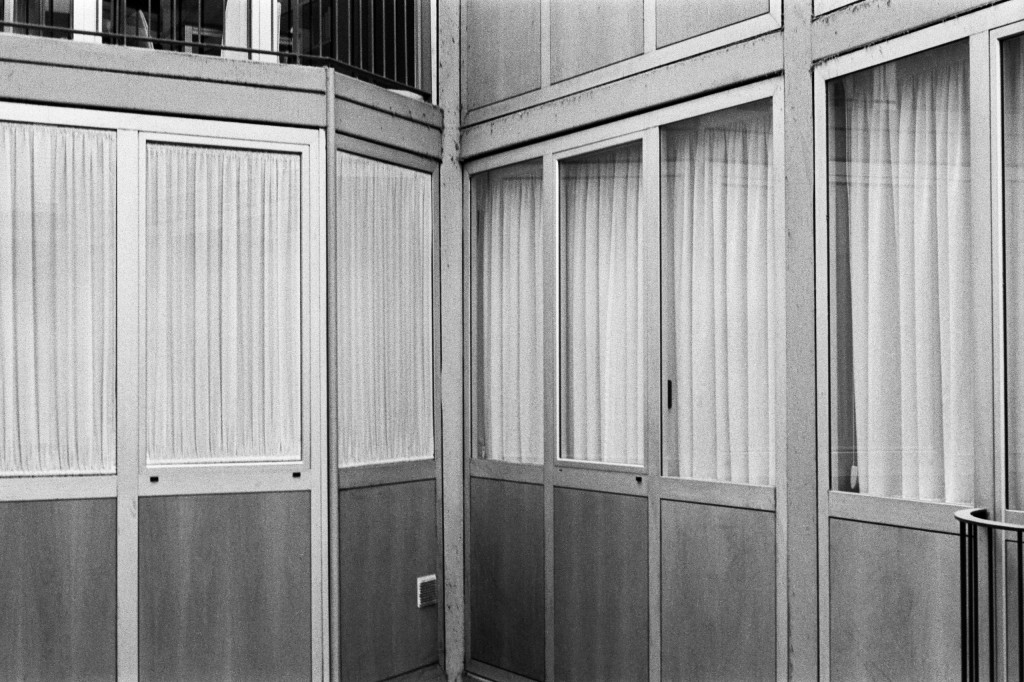
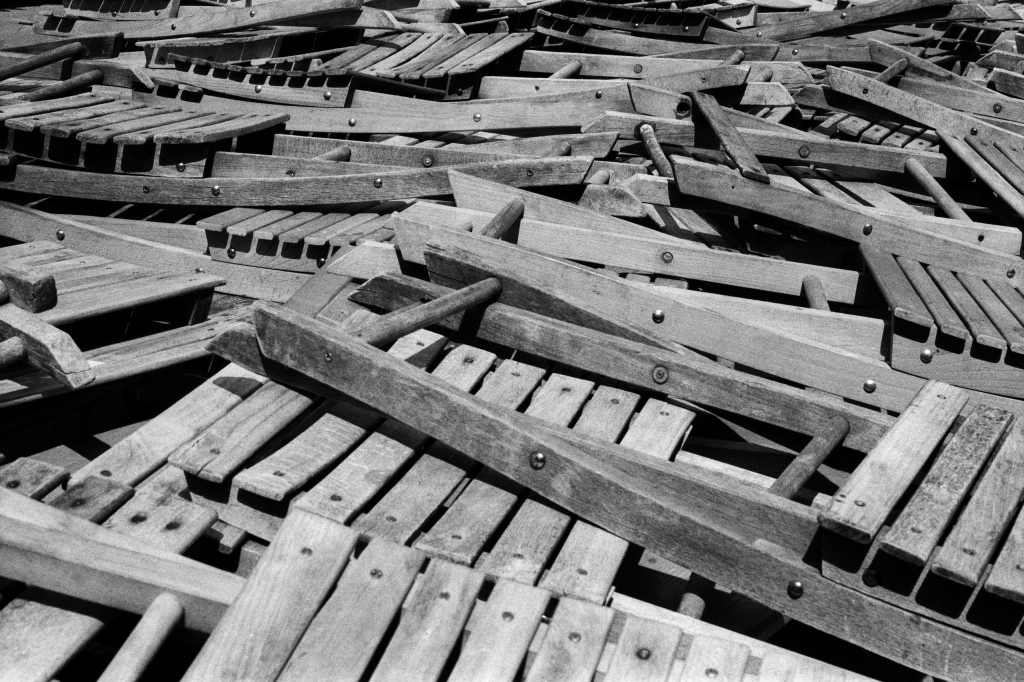
In Unseen, for instance, we look down upon the edge of the track, with its old heraldic concourse: above the shops, some shutters have been flung open, others remain closed; awnings protect the stands from the heat before the anarchy unravels (it is what these covers hide, we presume, which remains ‘unseen’ to our eye). It is a picture of revelation and concealment, vulnerability and abandon, a momentary time capsule which oozes the palpable state of anticipation–unbridled joy, to be sure, but also the fear of death and damage–which consumes the city during the Palio. Similarly, the curtains in Galleria remain drawn, presumably to protect the privacy of those inside from the throngs outside, and to shield them from the chaos. But no one stays home for the Palio. In another photograph, Onda (or ‘wave’, the name of one of the southeastern contrade), we find the unruly debris of perhaps a thousand fold-up wooden chairs; a reminder of the hard labour, by waiters or municipal workers, to maintain the leisure of the Palio.
One cannot help but notice the ways in which the Palio reflects the rich political history of this medieval city, which has so often combined a combustible mix of public decency grandiosely expressed with the open secret of scheming behind closed doors. As such, it is worth noting that despite its elevated status atop a hill, the Marian cathedral (duomo) is not the centre of this labyrinthine city: the Palazzo Pubblico, Siena’s medieval municipal palace, is its heart. Several of Young’s photographs reference the Palazzo Pubblico. It is itself the name of one picture, which depicts centuries-old columns casting intractably long shadows. The Palazzo was the seat of the Council of Nine (which lends its name to another photograph), who together with the Podestà (equivalent to a chief magistrate) were the advanced government of the Republic of Siena, performing executive functions (and judicial ones in secular matters). These local representatives lived together in the Palazzo Pubblico on rotating two-month terms, as they debated and conducted their legislative duties while Ambrogio Lorenzetti’s fresco The Allegory of Good and Bad Government reminds them ‘just how much was at stake as they made their decisions.’
Exhibition catalogue essay by Matthew Holman
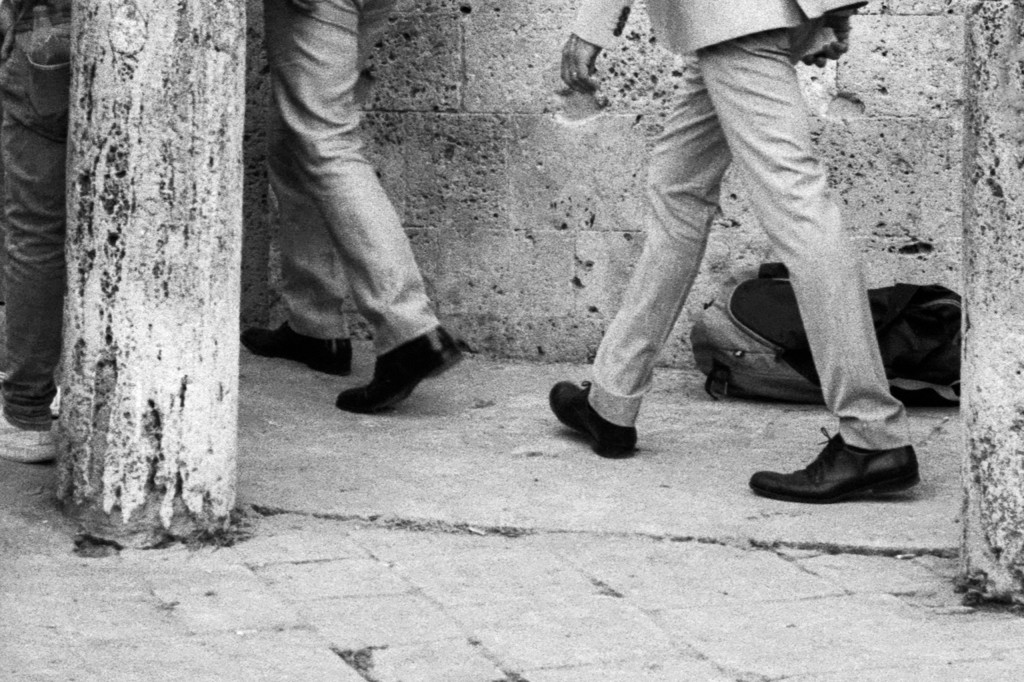
Council of Nine, like so many of Young’s photographs, looks away from the typical focal point of an image and to the dirty floor: in this case, to the tight suit trousers and brogues of a present-day dignitary or wannabe VIP who has some place to be. This is typical of Young’s perspective: looking down when everyone else looks forward or up, as they ignore the dust, smut, and shadow of the ground: which as we know is the site of all the real action. Compare, for instance, the perspective of Il Campo with Henri Cartier-Bresson’s 1953 photograph, Siena, also shot by an outsider to this insular city and its codes, its traditions, its fortified walls and big city gates (le porte). Given the topography of the city, with its walled observation decks and terraces in the sky looking down upon courtyards and restaurants, there is the opportunity for perspectives offered up by Cartier-Bresson and by Young. Both photographers capture the power of the modest subject, held in tension by distance rather than intimacy. ‘In photography, the smallest thing can be a great subject’, Cartier-Bresson reflected in his seminal essay The Decisive Moment: ‘[t]he little, human detail can become a leitmotif. We see and show the world around us, but it is an event itself which provokes the organic rhythm of forms.’ The same is true of Young’s photographs.
‘To look closely at [the work of the Sienese School] is to eavesdrop on one of the most captivating conversations in the history of art’, Hisham Matar reflected in his extraordinary memoir A Month in Siena, ‘one concerned with what a painting might be, what it might be for, and what it could do and accomplish within the intimate drama of a private engagement with a stranger.’ During her time in the city, Young was similarly captivated by the Sienese School and, in her work bearing that title, captures the predella depicting the Last Supper in Sano di Pietro’s Polittico di Santa Bonda (1455) in the Pinacoteca di Siena. Our gaze lands on Christ’s expression of resignation, and his outstretched hand towards Judas Iscariot who is the outlier within the assembled disciples as he is depicted without a halo. Christians look upon this scene and cannot disentangle the Last Supper from what comes next: Judas’ betrayal of Christ in the Garden of Gethsemane by kissing his cheek and addressing him as ‘master’. We know how the story ends. In the same way, I cannot look at di Pietro’s polyptych and not be guided by the knowledge of what came next for the Sienese School, the avant-gardists of their day. By the end of the 15th century, Siena finally succumbed to the teachings of their great rivals in Florence, who advocated for more naturalistic representation and geometrical perspective. The Polittico di Santa Bonda represents a late work of the city’s golden age. It is therefore an apposite choice of subject for Young, whose present series is interested in the lasting presence of history and tradition when those forces, so venerated in the city of Siena, come up against contemporary realities. Like Matar, Young has eavesdropped on the drama of the Sienese School as she has observed Siena from a distance, scrutinising its human carnival with a telescope.
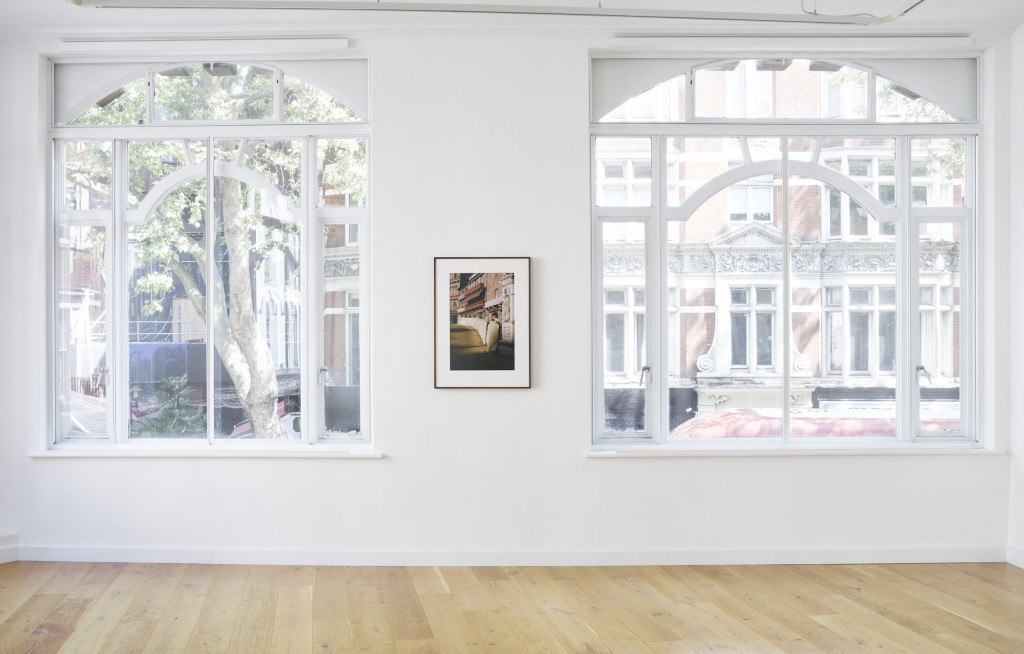
To conclude, it feels fitting to save the last words for The city itself, the only colour photograph in this series, which depicts one side of the campo: the barriers have been assembled, the balconies adorned with pink coverings. On a temporary scaffold in the distance, we see the flag of the Contrada della Torre (the tower); in the foreground, a saint in statuary gestures to the campo as though offering up benevolence to the riders to come. The square, for now at least, is deserted of people but it does not feel empty. The sun beats down on the dirt. The shutters are now open. The light reflects like broken glass on the windows. One might say that little happens in Young’s photographs, but that would be a misunderstanding entirely. They capture how much is going on even when nobody notices. They are pictures of the past as well as the present in a city which has always struggled to distinguish between the two. They cannot help but draw you in and say to yourself: if only it was this evening which promised the 6 o’clock in Siena. If only it was tonight. The chance would be a fine thing.