If you would like to request an exhibition catalogue, please email: cedric@cedricbardawil.com
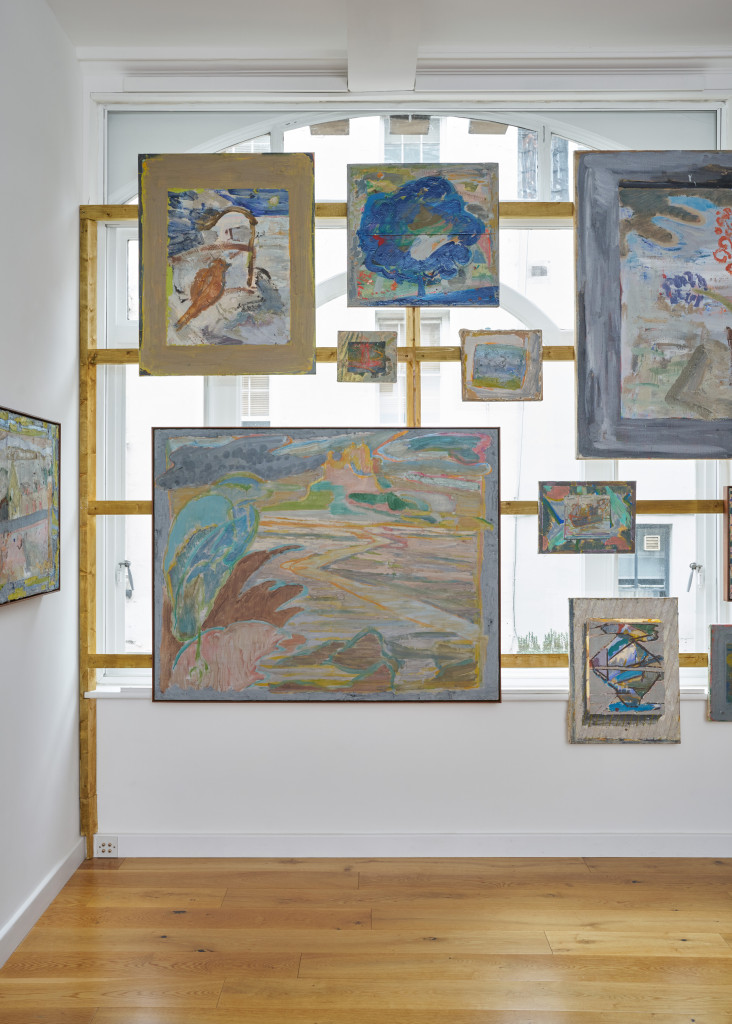
For Anthony Banks’ third solo exhibition at the gallery, ruins slowly ruin, birds migrate and return, wildflowers bloom and go to seed. There is a feeling of seasons passing, one time of year concluding to bring the possibilities of the next. Transforming the gallery into an artist’s atelier, Banks presents a series of completed works alongside those still in progress – offering a rare glimpse into a process usually hidden behind studio doors. Speaking of renewal, failure and desire, the exhibition is a reflection on the undulations of time, as moments – perfect or otherwise – come and go like a flower gone to seed. As the artist often spends over ten years completing a work – revisiting, repainting, reinterpreting – the exhibition straddles the new, old and still in progress to ask of us one simple, yet increasingly difficult task: patience.
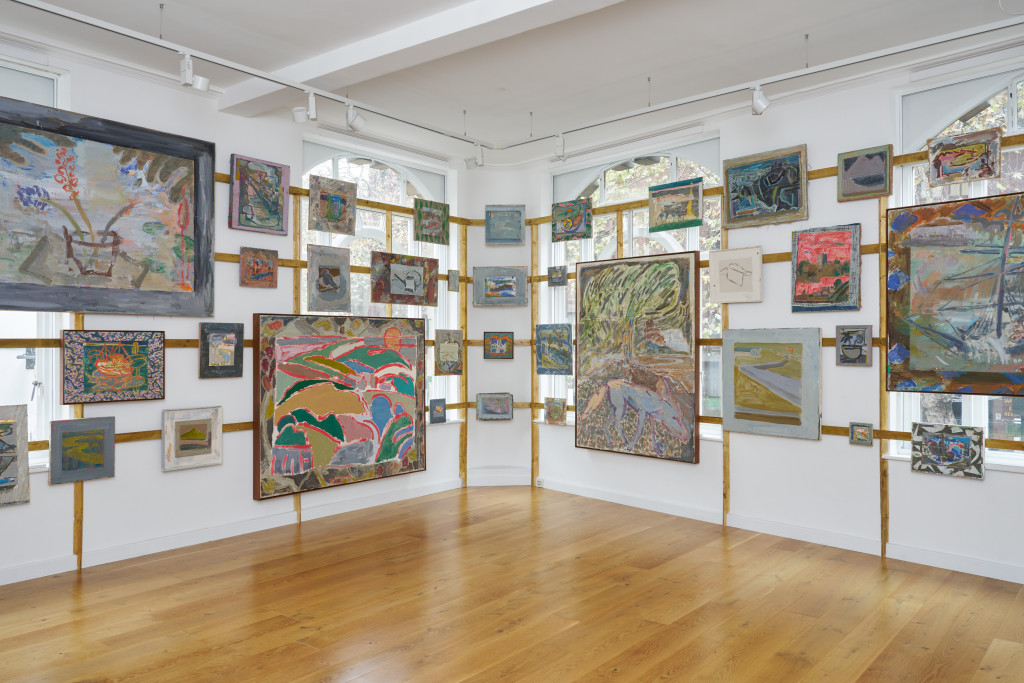
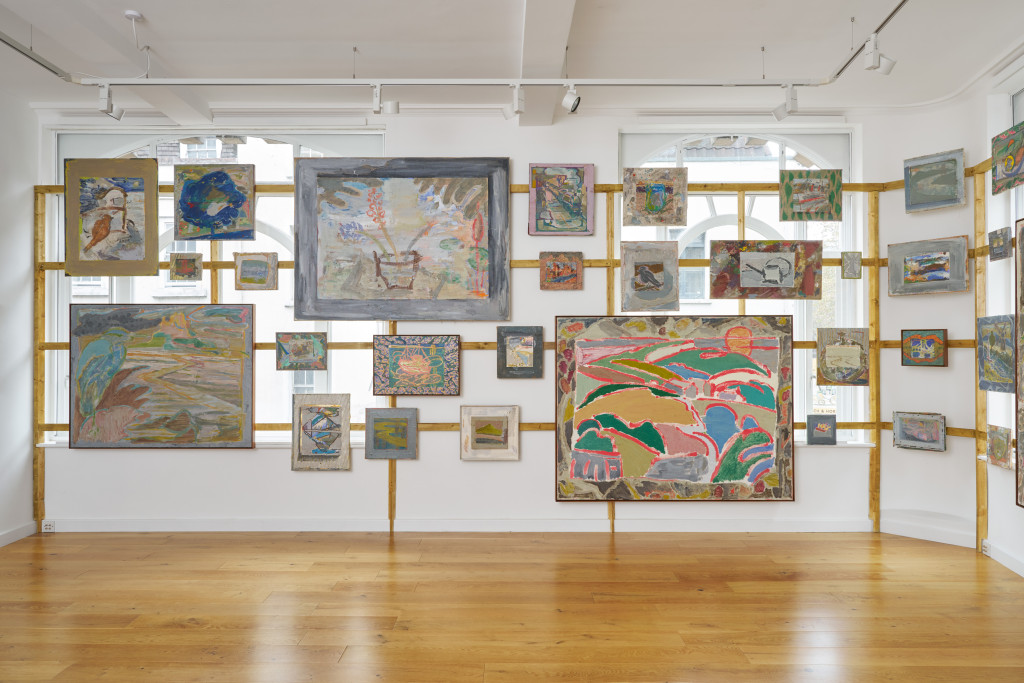
Anthony Banks – A Time to Every Purpose
Essay by Tom Morton
Beset by melancholy, the protagonist of William Shakespeare’s Hamlet (c.1599-1601) dismisses the world as ‘an unweeded garden / That grows to seed; things rank and gross in nature / Possess it merely’. Written almost two centuries before the emergence of the English Romantic movement, these lines find nothing sublime, or beautiful, in the vision of a landscape run wild. Rather, they drip with a fearful disgust at the ceaseless, ultimately ungovernable proliferation of organic life. For Hamlet, ‘nature’ is something to be kept in check, lest it ‘possess’ (or perhaps more accurately repossess?) the orderly spaces our species cultivates amid its seeming chaos, whether those be a neat ‘garden’, or a bounded and untroubled sense of self.
Hamlet’s words are echoed in the title of the British painter Anthony Banks’s solo exhibition Gone to Seed. In idiomatic usage, it expresses a state of decline, brought about through neglect, although we should note that it is also employed as a botanical term, describing a period in the life cycle of a plant, when it has passed through its flowering stage and is now focused on producing seeds, causing its petals to dry and fall. For the artist, this title gestures at once towards the impossibility of stasis (even the most perfect bloom soon fades, no matter how much we wish it not to), and the promise of renewal, which must be taken on trust.
Perhaps we might also read the words ‘Gone to Seed’ as referring to the fact that the paintings — the ‘flowers’ — on display in Banks’s exhibition are the product of long spells during which he has sequestered himself in his studio, a site of germination, where new shoots nudge slowly towards the light. The Biblical book of Ecclesiastes observes that ‘To everything there is a season, and a time to every purpose under Heaven’. For the artist, there is a time to paint, and a time to show, but the former season lasts much longer than the latter. He labours on each of his works over several years, sometimes setting them aside for long periods, like a fallow field, so that they — and he — might age, change, regenerate. His is an art that is born of the interplay between slowness (the layering of strata upon strata of paint) and speed (figuration being locked in quickly, and the rapid application of pigment to the support). Significantly, even when his canvases move from the studio to the gallery wall, he does not think of them as finished, but rather as ‘paused’.

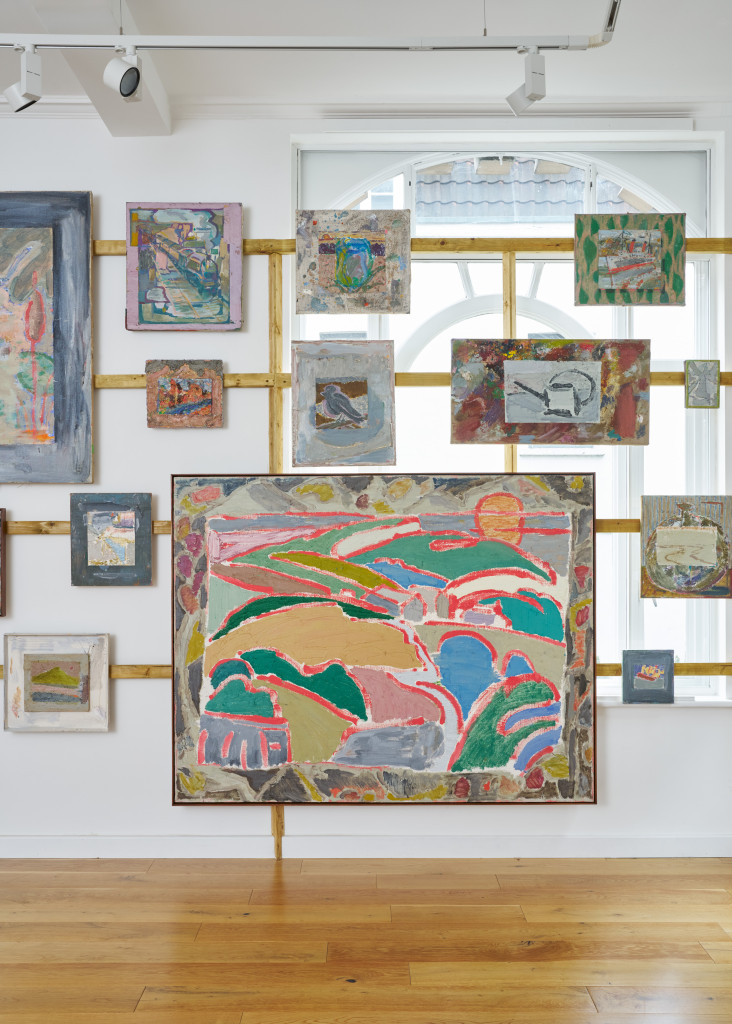
While landscape is (complicatedly) Banks’s genre, and painting his medium, the central concern of his practice is surely time. Look at his canvas Farm, Field, Cliffs (2018-25), an English vista in which each of the titular motifs expresses a different temporality: the arable land the annual cycle of sowing and reaping; the old, sturdy farmhouse the continuity between generations of agricultural workers; the ancient cliff face the unimaginable span of a geological epoch. Beyond these great white rocks, a blazing sun rises from, or dips behind, an orange horizon line. This life-giving stellar object, by which we measure out our days, is now some 4.5 billion years old. In another 7.5 billion years, it will enter its red giant phase, and destroy the Earth. For all that Banks’s painting might, at first glance, suggest a changeless pastoral idyll, it is a reminder that time — and nature — never really stands still.
If the artist’s imagery summons thoughts of major figures from 20th century English landscape painting — among them Paul Nash and Vanessa Bell, Eric Ravilious and Graham Sutherland, John Piper and Alfred Wallace — then this has a firm conceptual basis. As Banks has said, ‘landscapes have so many histories embedded within them’, and among these we might count the history of their depiction. The fact that our engagement with a given vista is always already shaped by who we are, and what we know, is explored by Banks in his works featuring animals, such as Fox, Willow, Fort (2015-25) and Causeway, Heron, Castle (2014-25). In each of these paintings, we see what was once a functioning military installation, which to the human mind at least tells a tale of a struggle for dominion over the surrounding landscape, of power won and power lost. And yet, to the fox and the heron that live in the vicinity of these structures, they are narratively mute — merely tall, hard masses that might provide welcome shade from the sun, or a convenient place to roost. In his work On the Suffering in the World (1850), the German philosopher Arthur Schopenhauer wrote that ‘The animal lacks both anxiety and hope because its consciousness is restricted to what is clearly evident and thus to the present moment: the animal is the present incarnate’. We are not so fortunate. To look through human eyes, to track the making, unmaking, and remaking of everything around us, is to be confronted, each day, with our own mortality.
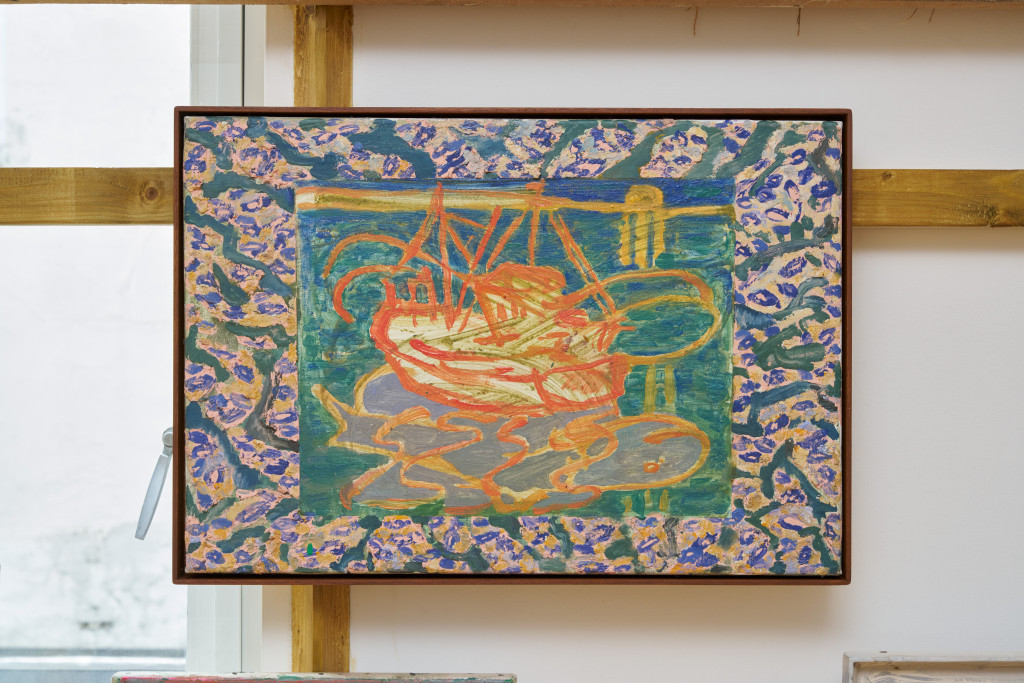
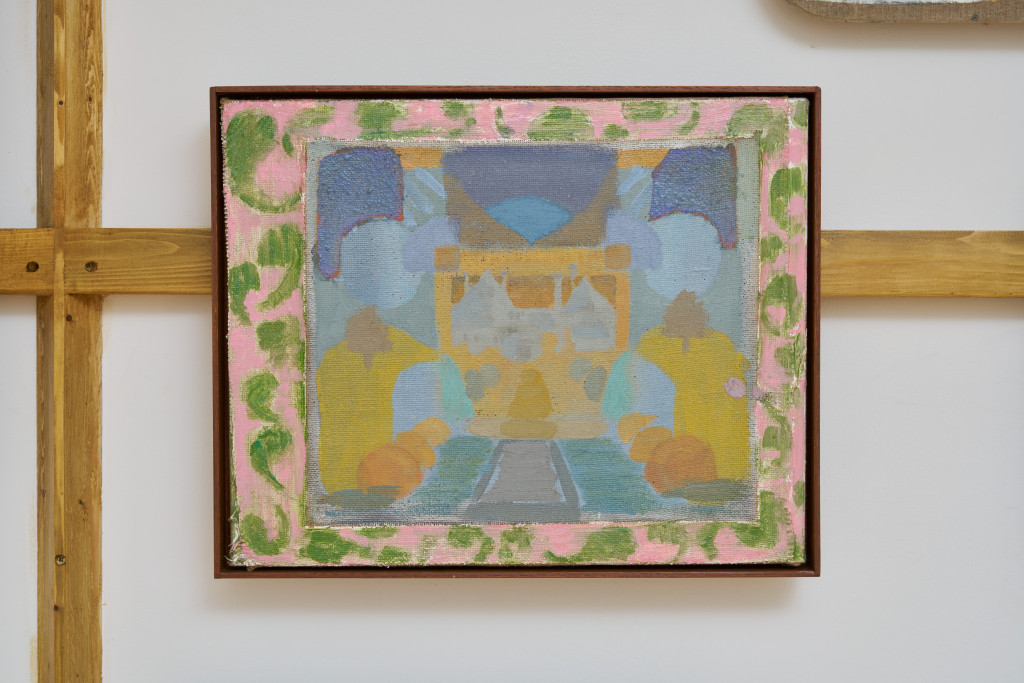
In many of the works in Banks’ show — among them Fishing Boat (2018-25), Shipwreck (2012-25), Stately Home (2008-25), English Riviera (2012-25) and Wading Birds (2011-25) — the landscape is bordered by a painted ‘frame’, into which its imagery spills, or else is met by what looks like a wall of stylized foliage or abstract pattern, rendered in a colour palette that might be harmonious, or distinctly discordant. The artist has called these areas the ‘suburbs’ of his compositions, and has spoken of how they allow him to deploy ‘two logics, two modes of description, two different ways of working’ on the same support. Considering this device, we might recall not only the way that painters of the past such as Wassily Kandinsky and Howard Hodgkin made use of the frame as a site of facture, but also the long history of paintings-within-paintings (Banks cites Vincent Van Gogh’s Self-Portrait with Bandaged Ear, 1889, which features the Dutch artist’s limber rendition of a Japanese print, as a particularly exhilarating example). In the works in Gone to Seed, one of the purposes it serves is surely to remind us that what we are witnessing are not landscapes at all, but rather their depiction, ‘framed’ by a particular mind. Reality, if it exists at all, does so beyond these images, and outside our perceptual reach.
Although Banks’s work records the impact of our species on the natural world — each tidy square of farmland, here, was once wrested from a wilderness — human figures are conspicuous by their absence. We might interpret this as a desire not to give his paintings a single narrative focus, or as an invitation to the viewer to imagine themselves stepping into the scene, and becoming its primary protagonist. Another thought occurs. What if the world he is showing us is one in which humanity has disappeared, leaving all of its forts and castles to erode gradually into dust, and ‘things rank and gross in nature’ to reclaim the landscape? This will, after all, one day happen. All it takes is time.