If you would like to request an exhibition catalogue please email: cedric@cedricbardawil.com
Triangles is a solo exhibition of new work by Gianna Dispenza (b. 1990).
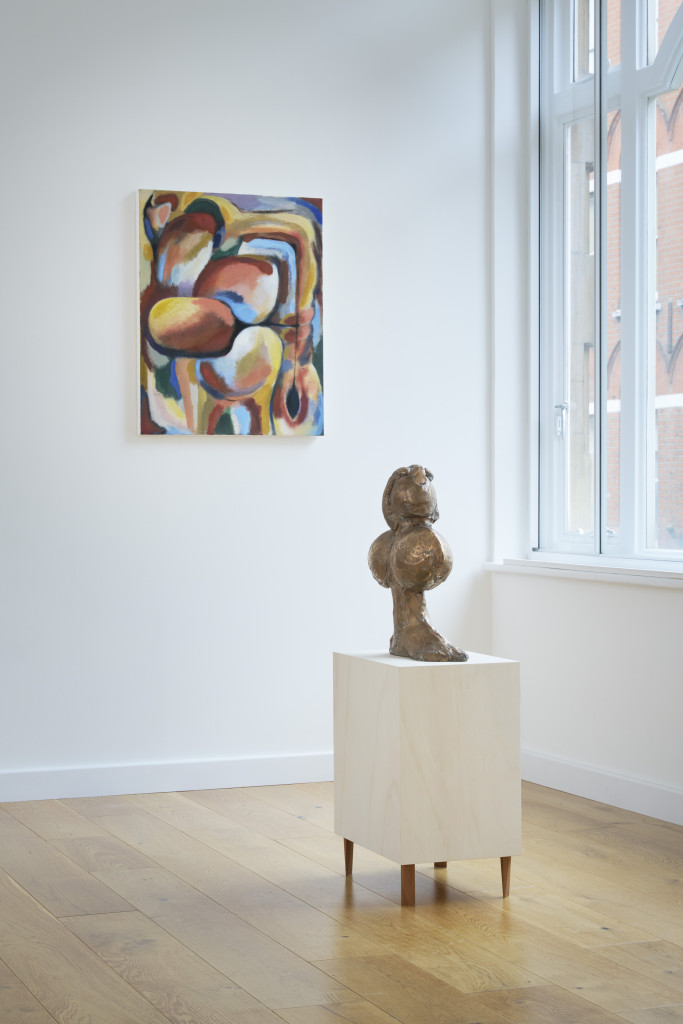
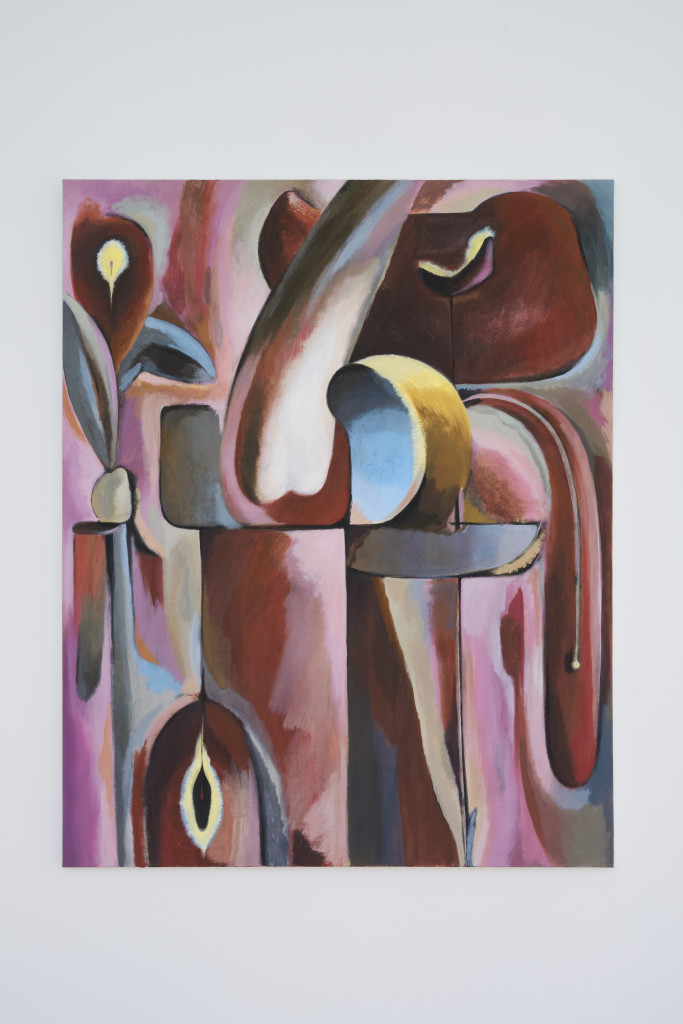
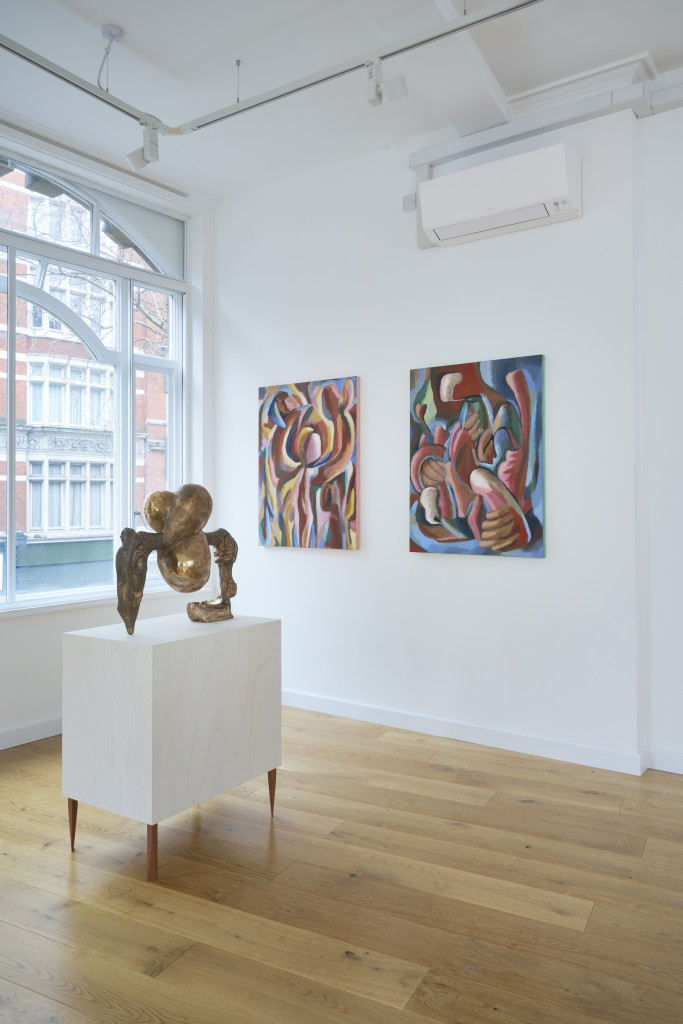
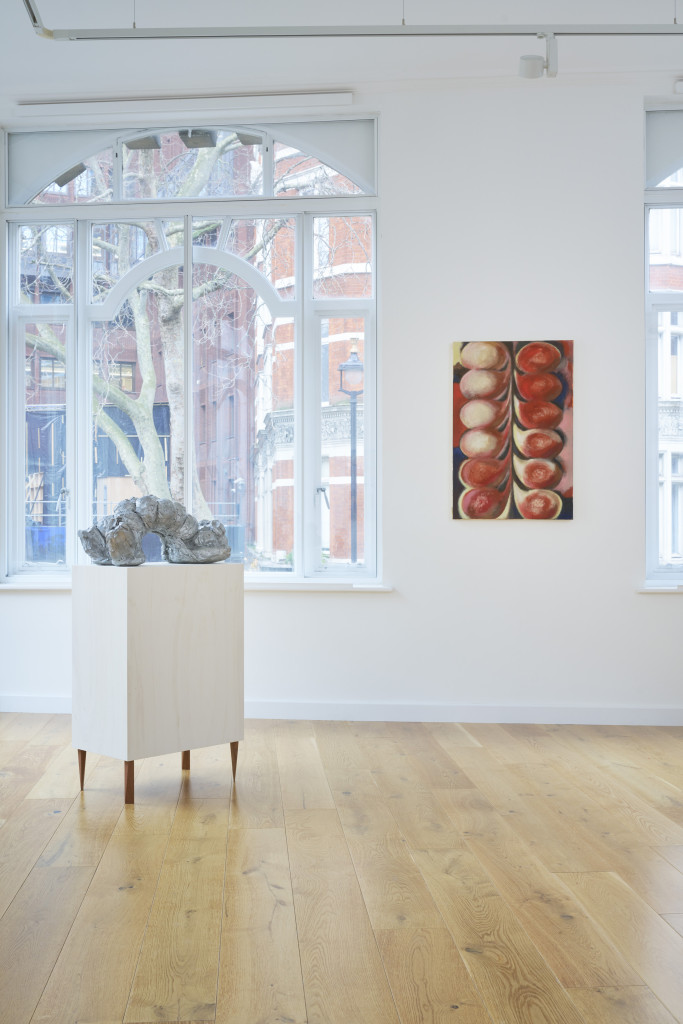
Distinctly female forms in Dispenza’s new painting and sculptural works jostle with an energetic rawness both familiar and foreign. Breasts, limbs, orifices and heads – both human and animal – amalgamate into creatures and scenes that defy provenance. They are the unexpected consequence of our contemporary moment; a moment defined by desire and an uncharted, frenzied awakening. Blending sand with coloured mineral powders and other materials such as concrete, volcanic ash and mud, Dispenza gives the surfaces of her paintings a kind of agency, the tactile, porous nature of the material performing its own presence. This sculptural quality of her canvasses, together with the ethereal nature of her bronze part-human part-other figures, thrust the works into a complex dialogue between narrative, form and space. Walking through and among Dispenza’s works, our own body and the space it occupies begin to transform and shift as familiarity collides with the unexpected.
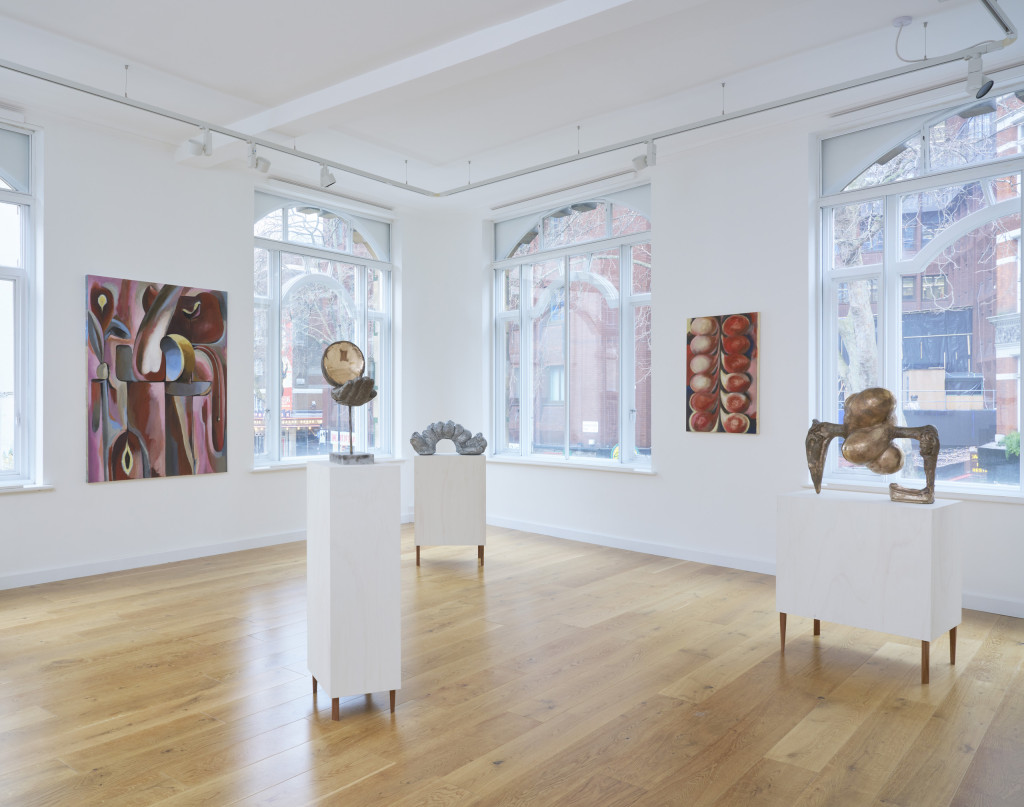
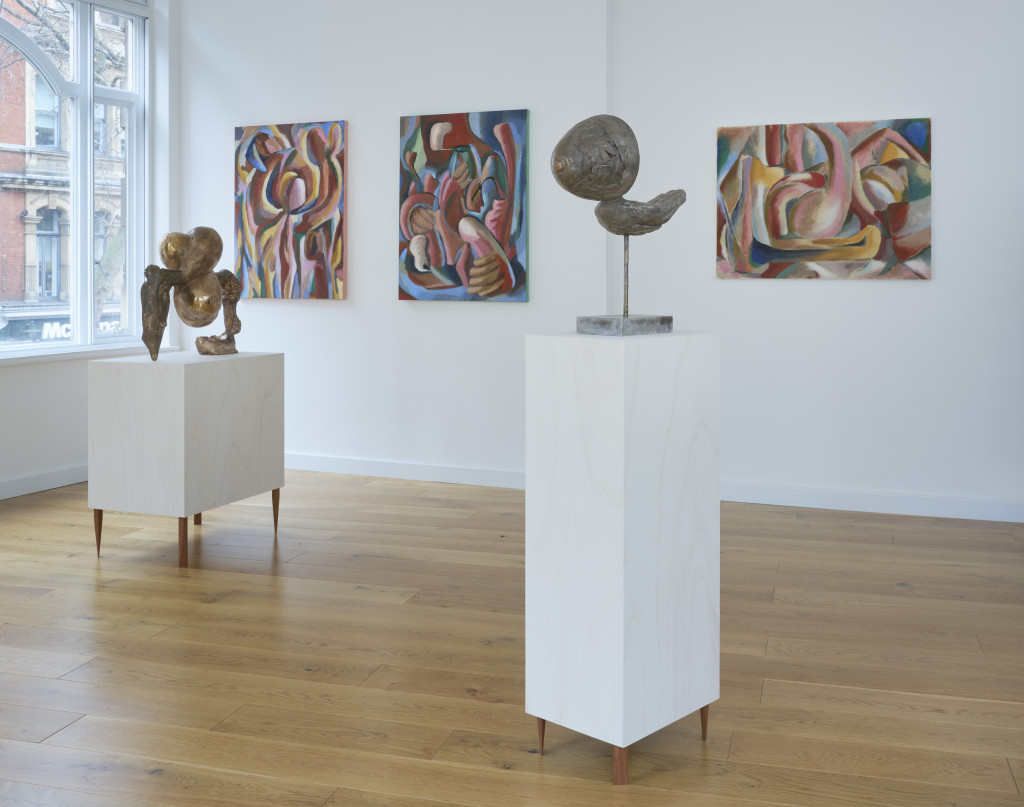
For Gianna Dispenza the triangle represents a set of principles that instruct and ground her artistic practice. Historically, the triangle is a symbol often associated with women – I’m thinking here of Judy Chicago’s The Dinner Party – yet in Dispenza’s hands the simple geometric shape and its feminine associations have been fleshed out to create the voluptuous, almost mechanical forms we see in her sculptures. In her paintings too, the triangle serves its purpose: the artist works in a triangulation of colour and saturation to create a distinct patterning with a deliberate focal point. Structurally, the shape informs the careful balance of each of her compositions, but conceptually the artist’s continued return to the triangle reflects the complex underpinnings of a body of work that questions entrenched associations and embraces a freedom in reimagining what is familiar.
Bringing to life the spirit of avant-garde movements such as Cubism, Surrealism, and Expressionism, Dispenza’s work evokes a deep connection with the aesthetic and theoretical concerns of Modernism, yet it bears a distinctive signature that calls us to engage well beyond its roots in this canonical movement. It is in her treatment of surfaces that this signature is realised, whether it be the polished mirror-like planes of her bronzes or in the textured, multi-layered compositions of her paintings that maintain flatness while pushing ever further toward a sculptural sensibility. From the beginning, I had an admiration for this material presence of Dispenza’s distinct surfaces. When she explained her unique approach and technical methods, I gradually understood how the strikingly tactile quality of her painting comes about: she combines mineral pigments with construction sand. In the past, she has also used concrete, volcanic ash, mud, and other found materials. This technique not only alters the surface but also introduces a playful unpredictability, where the organic pigments override conventional colour theory. Dispenza describes this process as a continuous relearning: “Mixing organic pigments yields different results than mixing the same colours in oil, so there is a process of relearning something I have spent my life honing and believing in – that orange mutes blue – but with these pigments orange and blue make purple. And pink and brown make an electric red.” Her works break through traditional and taught colour laws, creating outcomes that are instead found through experimentation and instinct. Her painting process typically begins with studies comprising figurative representations – women, festivities, groups in various activities – which the artist refers to as “sister paintings”. She further develops these initial compositions until they take on entirely new abstract forms in the final works. As these forms and compositions settle into place, their undulation across the canvas’s rough sand-clad terrain imbues them with an active presence. Dispenza denies the passive role of the canvas in lieu of a surface that performs a sculptural sensibility.
Despite their robust physicality, Dispenza sees this latest series of paintings as porous, “influenced by the conditions of my environment – sleep, books, memories, visual inputs, and mental states.” In this way the works are inextricably linked to Dispenza’s artistic command of herself. This conscious assertion has come about in part due to the continued association between her work and that of 20th century male painters, an association Dispenza believes is a reflection of the historical data gap and cultural erasure of many female artists from the same period. “Many of the artists I admire share a lifelong dedication – an obsession, even – with expanding, transforming or exploring surfaces,” she tells me.
Her push beyond the conventional canvas is not just a technical choice but also a challenge to established artistic and social norms. This emancipatory artistic expression permeates her entire work. In doing so, she manages to reconcile individuality and connectedness: biological and anthropomorphic forms assert themselves independently, yet gently blend into each other. The recurring earthy yellows, brown-reds, pinks, and blues create a harmonious yet tension-filled composition that visually captures this dual logic. Dispenza’s meticulous attention to surface and her ongoing exploration of transformation through materials and techniques are deeply influenced by her admiration for artists such as Jay DeFeo, Louise Bourgeois, Louise Nevelson and Eva Hesse.
The comparison between Dispenza and Louise Nevelson is particularly compelling to me. Nevelson, a pioneering sculptor, created monumental, monochromatic assemblages from found wooden objects, unifying them with matte black, white, or gold paint to emphasise depth, shadow, and abstraction. Despite working in different mediums, both artists share a profound engagement with materiality, surface treatment, and transformation. Nevelson’s fragmented, relief-like structures echo Cubist principles, much like Dispenza’s paintings. Spatial play is essential to their work – Nevelson constructs depth through shadowed recesses, while Dispenza’s textured surfaces and unconventional pigments create shifting planes within a seemingly flat canvas. Beyond their formal approaches, both artists engage with feminist themes, challenging traditional representations of form and asserting a powerful, tactile presence in their work.
When I first looked at Dispenza’s canvases, I was also reminded of Gilles Deleuze’s The Fold (1988). Deleuze uses the metaphor of the fold to describe how structures organically unfold, transitioning from linear, external dictates to internal growth. Feminist and psychoanalytic interpretations have associated this idea with the vagina as a symbol of depth, mystery, and origin. In Dispenza’s work, however, the female body is not mysterious or passive, but active, alert, and sometimes brutally raw. This energy continues in her latest series of bronze and aluminum sculptures.
Woman with Arched Back depicts a female torso with outstretched limbs, nine breasts, and a smiling face – a bold confrontation with cultural taboos. The woman in this sculpture smiles – not passively, but consciously – highlighting the ambivalence of a smile’s meaning. While it is often associated with warmth and sincerity, it can also express submission, defiance, or even aggression. Historically, it has been used as a tool of control, especially against women who are often urged to smile in public. It can also hint at shame, a feeling historically tied to female bodies. This sculpture breaks through such narratives and replaces them with a playful but commanding declaration of self-assertion, where the depicted woman, with her open legs and arms, boldly grins at the viewer. Here I am reminded of the artist’s inspiration by Rachel E. Gross’s Vagina Obscura, a nonfiction book about the female reproductive system and the patriarchal distortions in medical knowledge. In particular, Woman with Arched Back can be seen as a direct response to the silences and misrepresentations surrounding female sexuality. It speaks to the reclamation of feminine pleasure and power. Through her unfiltered and unapologetic portrayal of the female body, Dispenza challenges its historical sexualization while exposing gaps in knowledge surrounding women’s bodies.
The emphasis on the vagina, as Gross discusses in Vagina Obscura, is often linked to a history of both repression and distortion. Women’s bodies, particularly the vagina, have been subjected to a medical gaze that reduces them to organs of reproduction or sexual function, ignoring their broader significance in the contexts of identity, pleasure, and autonomy. Dispenza’s work, however, can be seen as a way of confronting this historical erasure and distortion. By incorporating forms that are suggestive of female anatomy in her sculptures and paintings, the artist reclaims the body as an active, complex entity, free from the restrictive and limiting narratives imposed by patriarchal medical frameworks. Thinking about this work reminds me too of Dispenza’s admiration for Miriam Cahn, a Swiss artist known for her raw and expressive works. Cahn explores themes such as gender, sexuality, violence, and the human condition in her paintings, drawings, and installations. Her works are characterised by almost painful sincerity and authenticity, qualities that are also at the core of Dispenza’s artistic work. Both artists share their mutual investment in the tactile, the visceral, and the unapologetic. They use the body as a site of resistance, transformation, and agency. While Cahn confronts the viewer with the direct, often brutal realities of bodily experience, Dispenza takes a more abstract approach, using materiality, texture, and form to engage the viewer in a dialogue about the body’s complexities. Together, their works form a powerful dialogue about the ways in which the female body has been represented in art and how it can be re-imagined as a space of both vulnerability and strength, pleasure and pain, passivity and agency.
This unyielding addressing and involving of the viewer is further evident in another of Dispenza’s bronze works. In Palm, the artist explores the tension between filled and empty spaces by merging an open palm with a rounded, breast-like form. This form is embedded in a polished, concave surface that reflects and inverts the viewer’s image, creating an interactive relationship between viewer and sculpture. The psychological depth of the work is particularly striking here, as the reflective surface invites the viewer into a process of self-reflection and forces them to confront their own identity. Palm emerged from Dispenza’s reflection on the nurturing quality of breasts – a characteristic often pushed into the background by their erotic association. The work urges the viewer to see familiar forms anew and to question their connection to their own body. The interplay of form, reflection, and self-awareness in Palm is particularly impressive. The open palm, symbolising receptivity or offering, contrasts with the rounded, breast-like form, evoking themes of care, femininity, and the maternal.
In another bronze sculpture, Mother, two opposing elements meet in a dramatic embrace that symbolises a confluence of forces. The bodies spiral toward each other, creating an intense dynamic that suggests movement even in stillness. The figures are grounded by their feet, which provides stability to the sculpture, while the spiralling forms appear fluid. This duality of opposing forces – the tension between movement and stillness – creates a powerful connection, as though the embrace is both a culmination and a moment of balance, where two energies unite. Despite the implied tenderness, the massive forms suggest an underlying, raw strength. The figures do not appear soft or delicate, but dense and almost mechanical, generating a machine-like energy. This contrast between the emotional warmth of the embrace and the physical strength of the forms creates an almost paradoxical tension. Texture here too is important, the polished and unpolished bronze swirling together in an endless cycle of renewal.
This seminal body of work, which for the first time combines the breath of Dispenza’s sculpture and painting practice, is a call to engage with the raw, untamed forces that shape our identity and perception. Functioning beyond the mechanics of contemplation, viewing these works together urges us to become part of their narrative and to question the conventional notions of the body, of femininity, of materiality and of strength. Triangles constructs a dynamic space where the organic and the abstract, the maternal and the defiant coexist in tension and harmony, leaving a visceral and lasting impression on how we understand ourselves and others.