If you would like to request an exhibition catalogue, please email: cedric@cedricbardawil.com
‘Every Window is a Holiday’ is Alice Macdonald’s debut solo exhibition with the gallery.
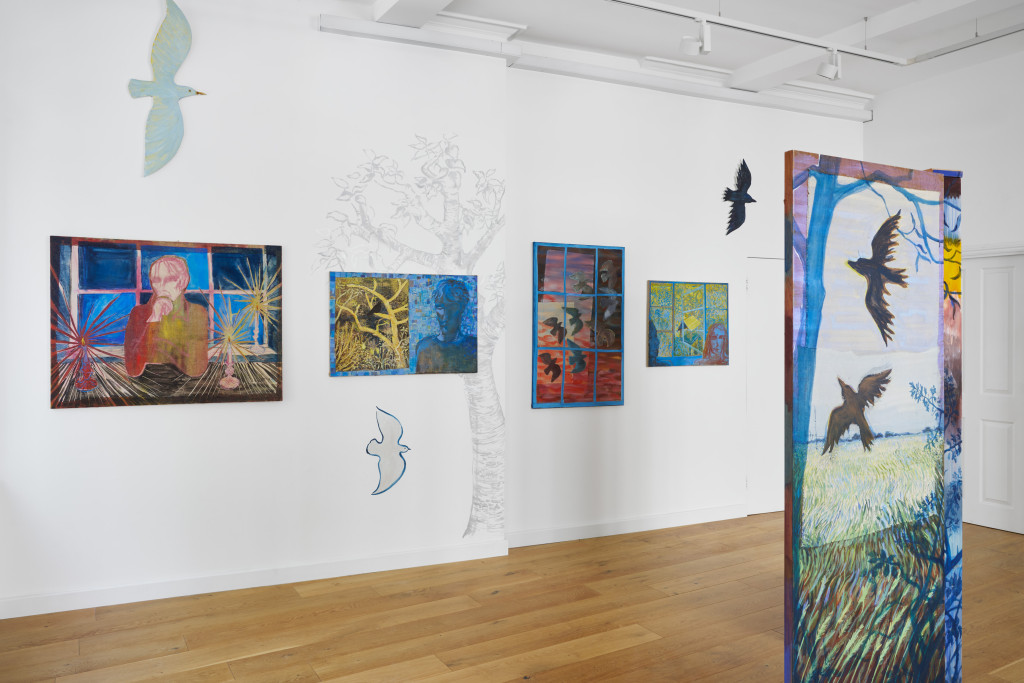
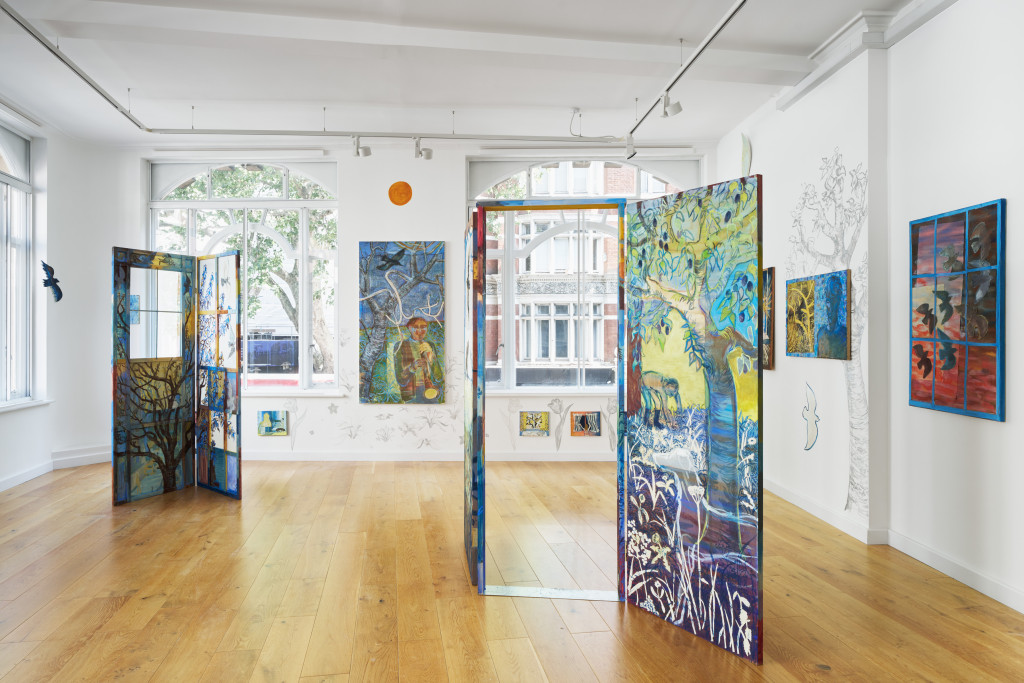
“Macdonald paints at the threshold. Her canvases return to the charged moment of looking out: from the kitchen sink, or through the window grid, catching sight of a barn owl caught mid-flight in the blue dark beyond the glass or a pair of birds banking over a field. ‘Every Window is a Holiday’ brings together new paintings alongside painted screens set free-standing in the gallery, which you can walk around and through. On one face, kites above a Van Gogh field; on the other, a fruit-heavy tree and someone tidying the garden. It’s a door that goes nowhere, stripped of its wall and its frame and its destination, until only the gesture of crossing over remains. Macdonald’s paintings work the same way, sitting at the boundary between autobiography and fiction, never quite resolving the question of which side you’re standing on. The floral mural she is painting directly onto the gallery walls has already made the countryside a room.”
— Matthew Holman
Every Window is a Holiday: Alice Macdonald’s Rural Bohemia
Essay by Matthew Holman
‘But John, don’t you think that people make a distinction between a story that is true and a story that is imagined or invented?’
— Susan Sontag, to John Berger, Voices
(‘To Tell a Story’), 1983 television conversation, Channel 4
The opening lines of Dodie Smith’s I Capture the Castle (1948), one of artist Alice Macdonald’s formative novels, find the seventeen-year-old narrator Cassandra Mortmain wedged on the draining-board of the kitchen sink, feet dangling in the basin, a dog’s blanket and a tea-cosy for cushioning, writing by the last of the available daylight. The smell is carbolic soap, and her position is undignified. She notes that she has found something generative in sitting where she has never sat before—her best poem, she reports, was written on top of the hen-house, though she immediately adds that it wasn’t very good, and that she has resolved to stop writing poetry altogether. The passage is funny and self-deprecating and entirely unsentimental about the conditions under which the desire to record takes hold. It establishes from the first sentence the novel’s central preoccupation: the attempt to fix experience in language before the light changes, from whatever awkward position the moment requires. Macdonald’s paintings occupy something of the same threshold, as they oscillate in perspective and in memory between the inside of an all-too-familiar domestic space and the view pressing in from outside; like Cassandra, her attention is restless, her subjects already disappeared into the half-light by the time the artist’s brush reaches the canvas.
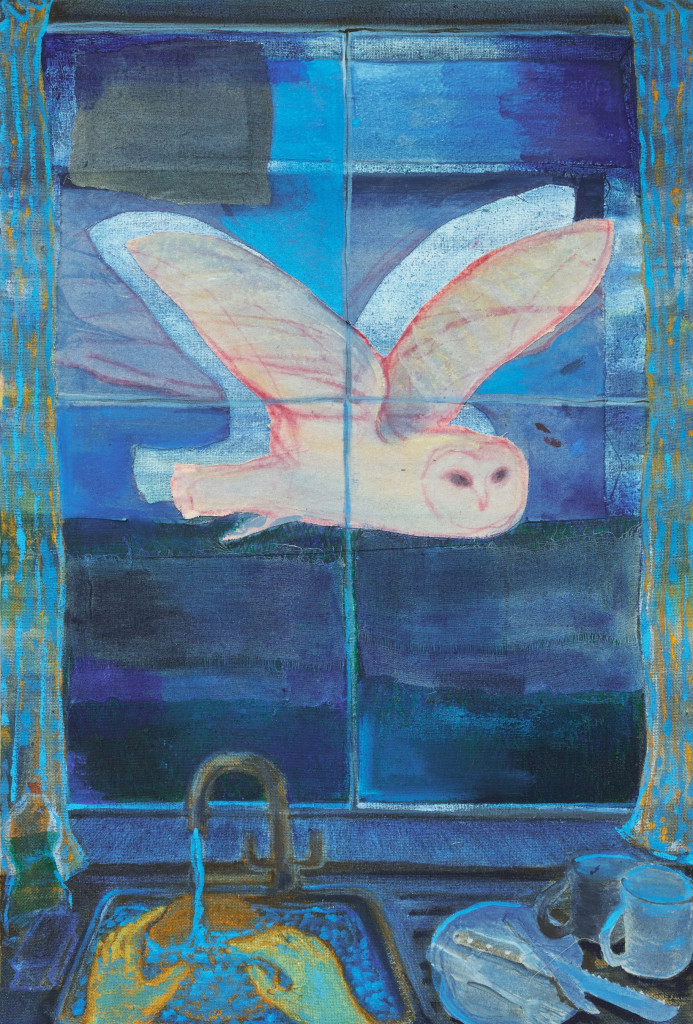
In Messenger (2026) we find ourselves where Cassandra writes: by the kitchen sink, looking through the window into the pastoral twilight. Macdonald’s painting, made from distemper and collaged fabrics on hessian, is structured around the doubled attention that defines her practice: the domestic foreground of sink, tap, draining-board and submerged hands in gold, and beyond the glass a barn owl caught mid-flight in the blue dark, wings spread wide across the window’s grid. The owl holds special significance for the artist, and not merely as the nocturnal envoy of the field’s edge. Macdonald has written of talking to a friend on the phone, a friend who had recently lost her partner, and the owl that swooped over her head at that moment, which they both felt was a message from him. Whenever she sees an owl now it carries a sense that the natural world is not indifferent or remote, but alert to us—that attention, paid long enough and carefully enough, is circuitously returned. The faint double of the owl—its ghost visible beneath the main figure—introduces duration into what might otherwise read as a frozen moment: the bird is not simply there but arriving, or departing, caught across a span of time rather than fixed in a single instant. This is not, to be sure, a photograph taken with flash; it is partly a consequence of the distemper technique, in which layer shows through layer and the ground is never fully suppressed, as the image accumulates like sediment in still water rather than flatten into a single transparent surface.
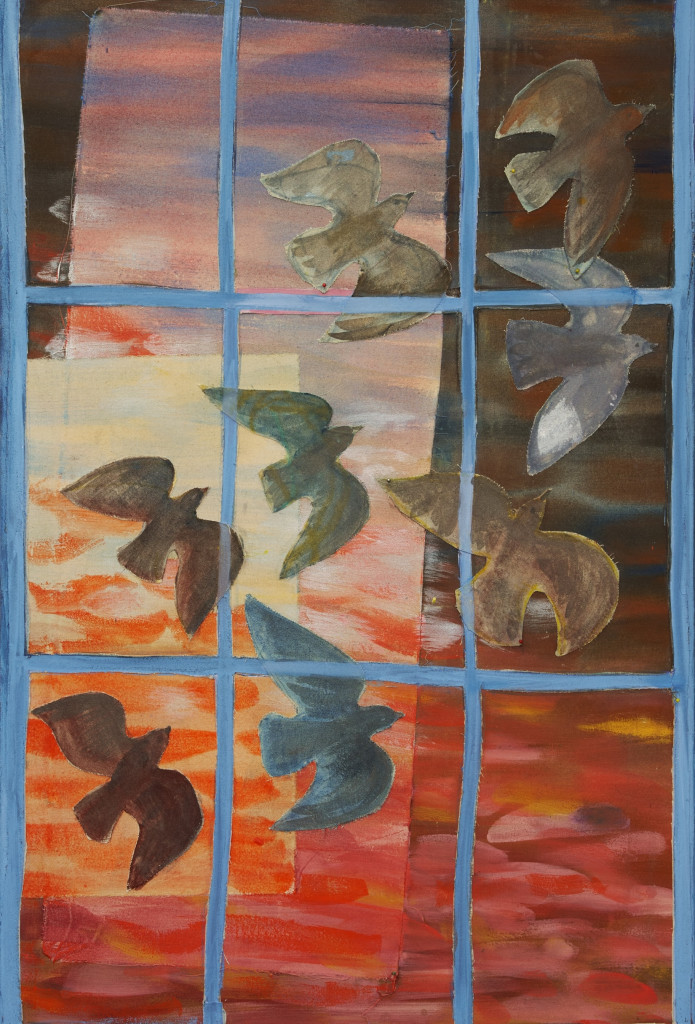
Elsewhere, in works like The Wind Blows the World Around (2026) we see two birds, a black crow and a white gull, fly on the other side of a grey window frame, banking above a cornfield: it is dusk, I think; the time of insects. The yellow field has the otherworldly intensity that distemper makes available—a brightness oil paint would almost certainly muddy—and the window grid divides the sky into four compositional units, the birds distributed across them like elements in a decorative scheme, their movement held by a particular kind of balanced structure that invites us to see them, first and then second, left and then right, as a kind of reflection in opposite colour and scale. Édouard Vuillard, who worked in distemper for his early Nabis panels and the decorative schemes of the 1890s, used the medium’s matte opacity to flatten and compress, encouraging figures and ground to press into each other until space, perhaps a wildflower garden or a quiet interior, becomes pattern. Macdonald’s window executes the Vuillardian compression but from the other direction: where the French artist pushes the interior outward into surface, she pulls the exterior world—field, sky, crow, gull—into the ordering logic of the frame, the glass then becomes both soft barrier and imperfect compositional grid, the outside world simultaneously present and held at one remove.
As I’ve already intimated, Macdonald mixes her own paint from rabbit skin glue and dry pigment—the same glue she uses first to prime the surface, and then again to fix the canvas collage in place. She stopped using oil paint some time ago. The glue is thinner than oil, a jelly when cold, and she has to keep it warm as she works. It gives her more control over colour, and makes brightness easier to reach as the pigment sits differently, less slushy, a medium that wants to slow everything down. As any child will tell you, the glue has its own demands. It sets quickly, it requires attention, you cannot ignore it, and in this way it moderates something in her: put simply, the urge to work fast. Candle Lit (2026) is a case in point. A figure, perhaps the artist’s mother, sits at a table between two candles, chin resting on hand, the window behind them filled with deep blue as that ferocious candlelight radiates outward in spiking starbursts of red and gold burning with the quality of marks made into or onto a collaged surface, scored or drawn through layers rather than brushed on top of them. The darkness of the table and the border has the density of distemper burnt umber, though sometimes looks like pure black—more like an absence of light, we might say, than the distinct presence of pigment—and against it the pink of the figure’s face and the warm ochre of their body hold their intensity, never looking as though they may sink and recede into their own loneliness. What the painting demonstrates is how the two elements of Macdonald’s practice work together: the collage provides a dependable structure and surface as the distemper offers colour that stays bright and distinct rather than blends into atmosphere. If Macdonald’s subjects sometimes get lost in their surroundings, distracted and subsumed as in a reverie, her materials never allow them to drift off completely.
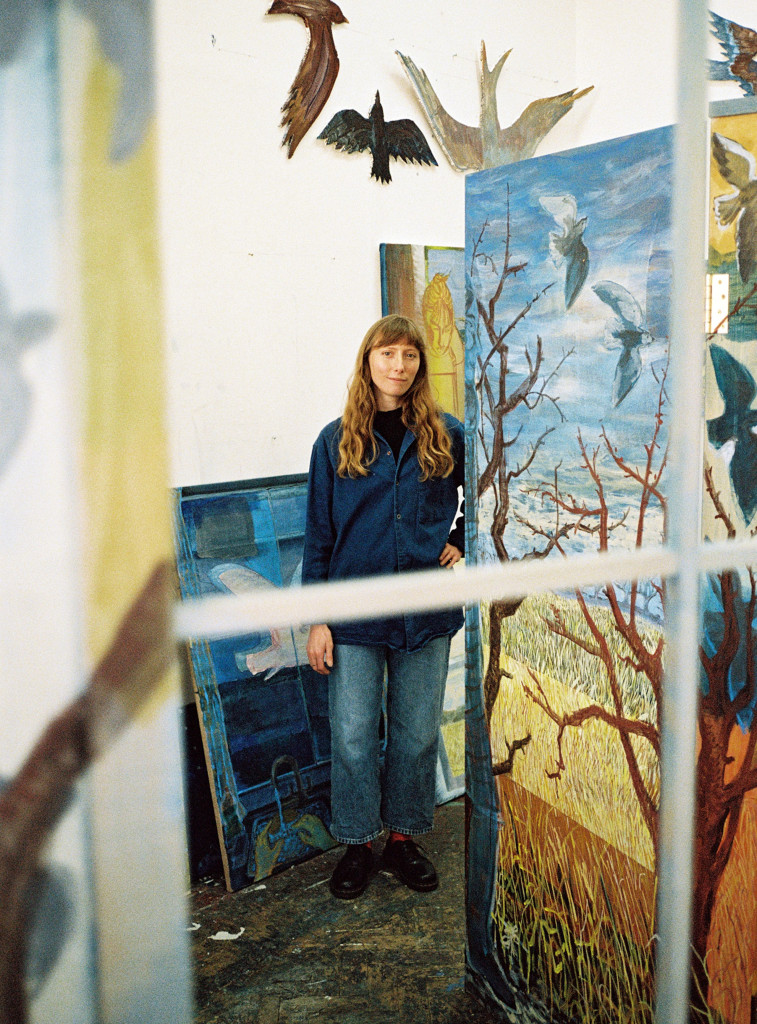
Macdonald is a painter of a particular kind of rural bohemia. Let me try and put my finger on it. In Self Portrait in the Studio (2025), Macdonald depicts herself standing and painting at full-length—the ceiling fizzes a kind of incandescent blue, an arched window behind her giving onto grey-green sky, pots of pigment at her feet, a brush held loosely in one raised hand. She wears a striped top, a dark skirt, wide-leg trousers, white trainers; her long hair falls across her shoulders. Look closer at her shoulder, her torso: the paint seems to move through her, and then the floor shows beneath her legs, as the background presses forward, and yet the expression she returns to us is direct, wholly present. To look at the window over her left shoulder alongside those earlier discussed—every window is a holiday, as the title of this exhibition tell us; every dawn an escape route—is to see how varied this returning subject is for her. In the self-portrait the darkness outside appears languidly wet and porous, like algae, and in its own way nearly entirely abstract as the encroachment of the windowsill into her hair and her shirt dissolves all distance between herself and her small portion of solitude, her atelier. Paula Modersohn-Becker comes to mind, particularly the self-portraits from Worpswede and Paris in which she places herself before the canvas with a similar matter-of-factness: a woman in a working situation, looking out at you, the studio as the natural habitat of someone attentively engaged in the act of self-examination, never merely a stage for its display.
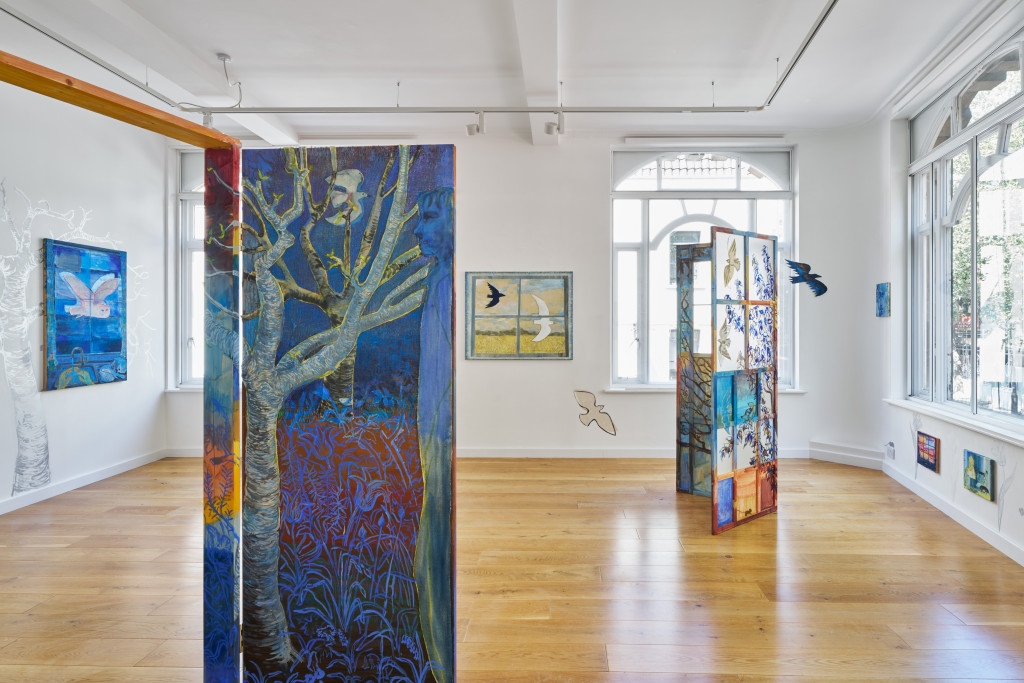
As you will have already seen, one of the most striking aspects of Macdonald’s present exhibition is Looking in Different Directions (2026), a painted door screen, that does away with the metaphor of a threshold completely: two hinged panels, life-size, painted on both sides and set free-standing in the gallery so that you can walk around it, pass through the space it delineates, see both worlds at once. On the outer face: crows wheeling above a field of long, Van Gogh-in-Arles grass, the sky pale and wide. On the inner face: a tree heavy with fruit, and someone tidying up the garden. I am struck by the visibility of the hinge and the brass: Macdonald makes no attempt to conceal the object’s function and yet that function as a threshold, as an entrance to a room or building, is undermined by its portability. Macdonald’s door could be opened out in the gallery, or placed once again in the Oxfordshire field that is represented on its panels, or else on the Soho street. It is a door that goes nowhere and separates nothing, and yet the distinction between its two faces holds. To stand in the gap, the door open at ninety degrees, places us in the position that so many of her paintings do: we are caught between a domestic interior and the world outside, between the place we call home and something stranger, often defamiliarized, even deathlier.
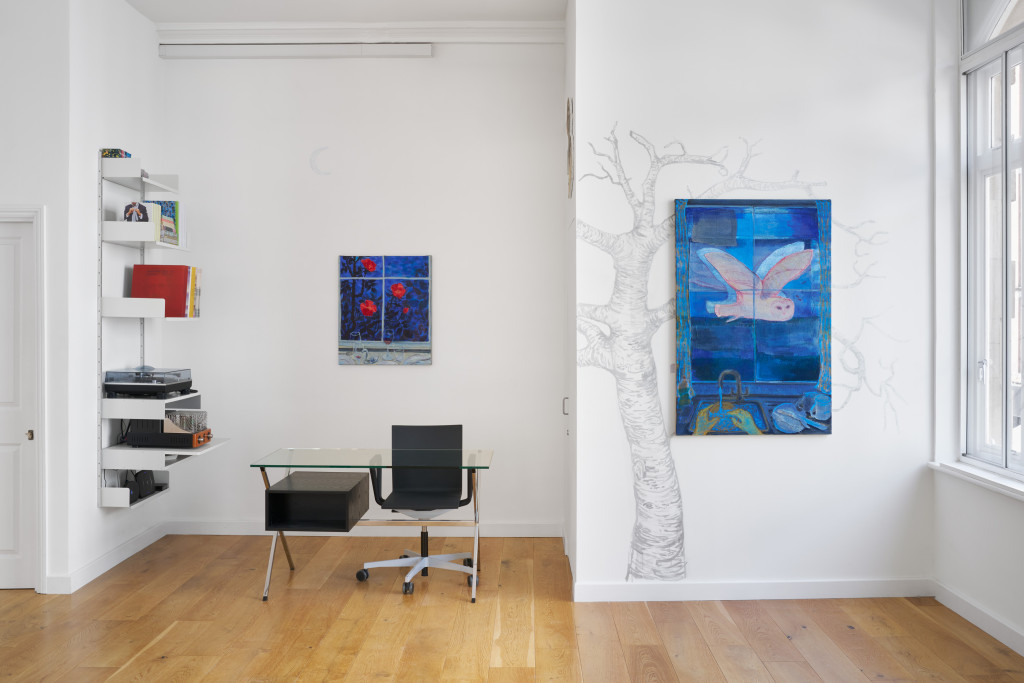
‘The one border we all cross, so often and with such well-rehearsed reflexes that we barely notice it, is the threshold of our own home’, Frances Stonor Saunders writes in her essay ‘Where on Earth are you?’ ‘We open the front door, we close the front door: it’s the most basic geographical habit, and yet one lifetime is not enough to recount all our comings and goings across this boundary. What threshold rites do you perform before you leave home? Do you appease household deities, or leave a lamp burning in your tabernacle? Do you quickly pat down pockets or bag to check you have the necessary equipment for the journey? Or take a final check in the hall mirror, “to prepare a face to meet the faces that you meet”?’ Macdonald reminds us that we cross such boundaries every day, and her door is the rite actualised in three-dimensions, lifted from any pure use value—the threshold stripped of its wall, its frame, its destination, until only the gesture of crossing over remains. And in the floral mural Macdonald is painting directly onto the gallery walls, the outside has already come in: the room is in the full bloom of the English countryside in spring, bringing to life her theatrical sense that storytelling faces in two directions at once—toward what is real and toward what is dreamed, toward the field you left and the room you entered, never quite clear about the role to be played in either.
‘The paintings that result in the end are neither wholly autobiographical nor completely fictional’, Macdonald says. ‘Rather than portraits or reportage I see them as evidence of my attempt to understand the world around me. They are a record of the time spent looking, drawing and thinking about my subjects. They are also a depiction of my sincere relationship with, and love for, the people and places I paint.’ The distinction Sontag presses Berger on—the one between the true story and the invented one—turns out, in Macdonald’s hands, to be happily unresolvable. Janus, the Roman god of doors and transitions for whom January is named, and on whom Macdonald has recently been reading, was depicted with two heads facing in opposite directions: what has been and what is still to come held simultaneously in a single figure, a reminder that they do not live in separate houses. Macdonald’s windows work the same way, and so does her practice: they manage to be both a record of lived experience, somehow always when the light is changing, and an irrepressible sense of reinvention, as the beloved face and the dissolving ground make way for a completely unfamiliar way of looking at the world. That is, finally, what the attention is for.