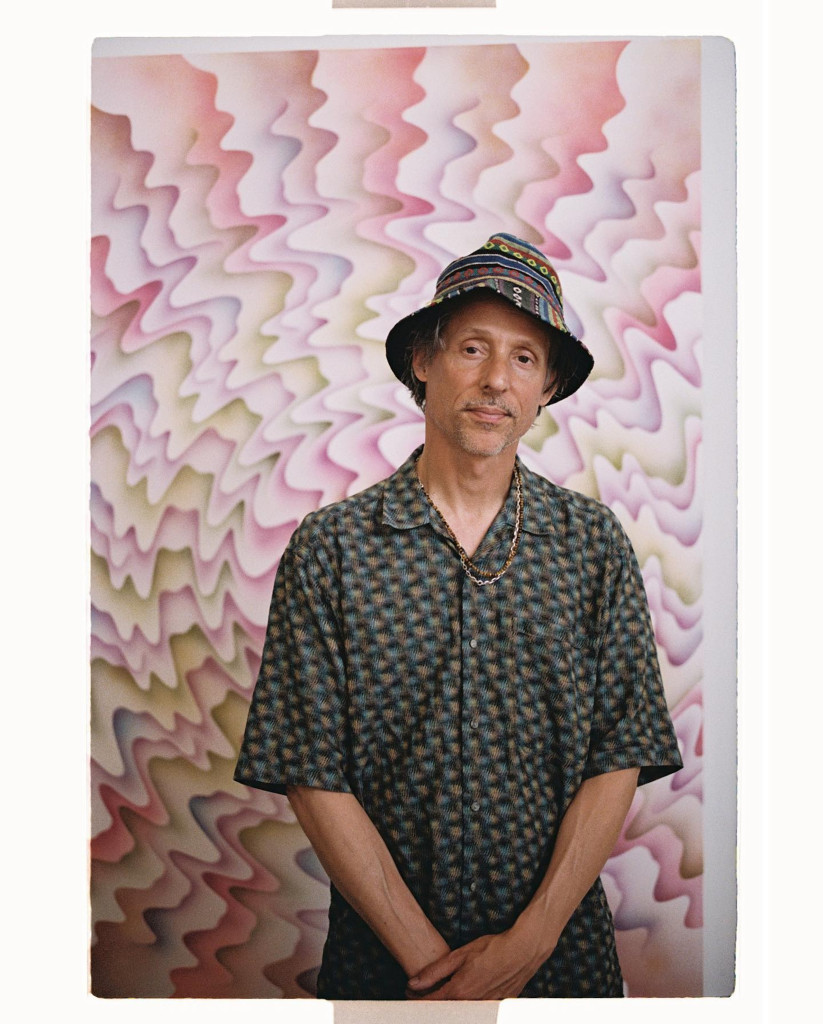
A solo exhibition of new works by L.A. based artist and musician, Eddie Ruscha.
If you would like a preview catalogue, please email: cedric@cedricbardawil.com
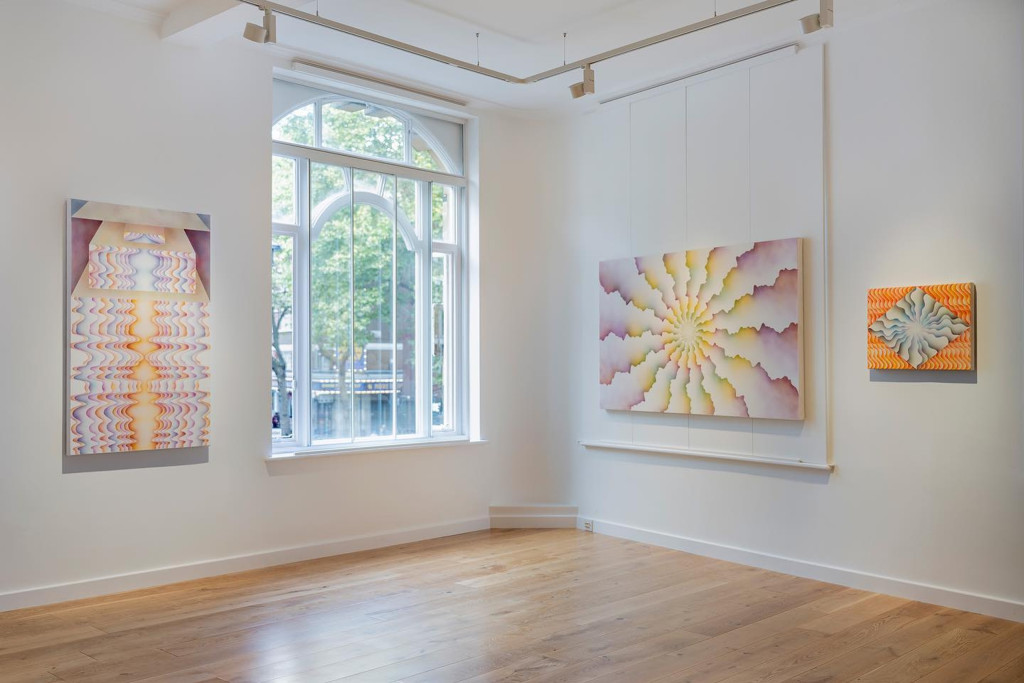
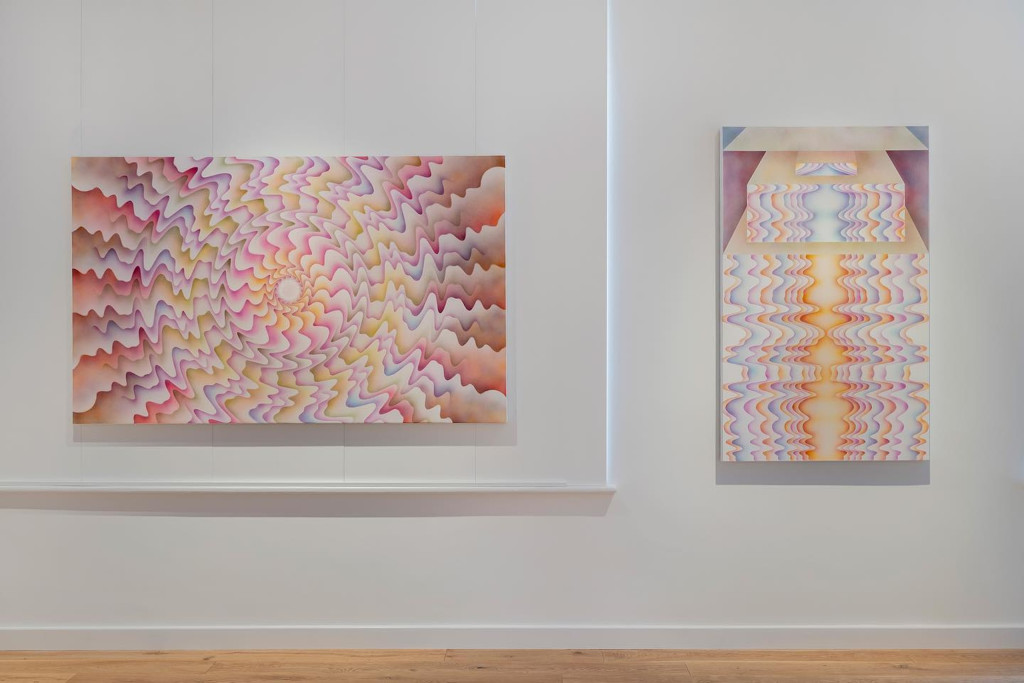
In their dazzling transformations of pigment into their own spatial logic, Eddie Ruscha’s canvases stand as an ambivalent homage to his home town of Los Angeles. Ruscha does not represent the specific contours of L.A.’s topography—its right- angled gas stations in the urban desert like his father, Ed Ruscha, or its manicured celebrity beaches that have nothing to say and are saying it, or the city’s endlessly coiling freeways lit up like famished firelies at dusk. Indeed far from it. But his canvases do conjure an extraordinary transhistorical portrait of a city that Mike Davis, L.A.’s great chronicler, stressed goes way beyond Hollywood pop and Didion ennui, when he labelled the city a ‘night on fire’ (1). Confronting an Eddie Ruscha painting can feel like stepping into a vortex. It propels you sideways. You’re invited in. But Ruscha’s paintings are no more about the place of L.A. than Piet Mondrian’s block squares are about New York skyscrapers.
Ruscha manages to take abstract subjects, many conceived as visual representations of wave formations—the moiré pattern, the disc, the swirling gyres that thrust Op-Art aesthetics in newly digital directions, as Timothy Leary predicted when he anointed computers the ‘new LSD’—in order to reflect on more than the place of southern California in his mind or out there. Instead, these are paintings about space itself, and about our highly individuated perception of space, or what Paul Cézanne has described as the colours of art that operate at the threshold where ‘the brain and the universe meet’ (2).
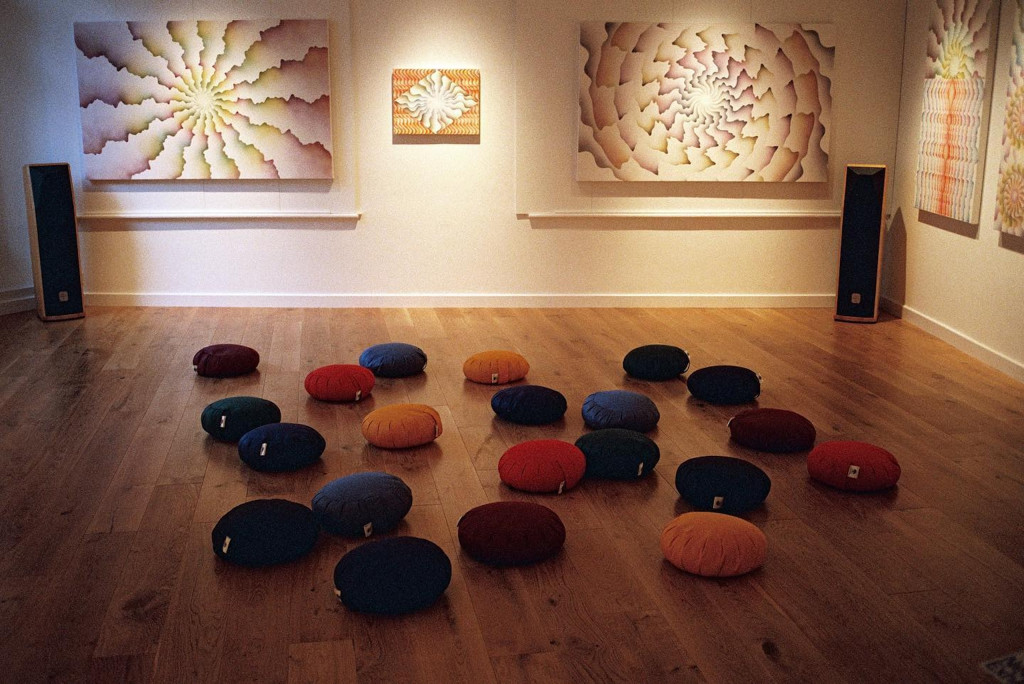
In the paintings that make up the present exhibition Sound / Waves, Ruscha imagines entirely impossible vistas of luscious colour based on what is already foundational and spatialised in our world. These are found in the pulsing vibrations that make up our experience of music, and the impossible beauty of mathematics. Ruscha’s paintings play tricks on your mind’s eye, only to more properly tell you the truth about the order and chaos of the material world around us.
Ruscha’s studio is nestled on a precipitous hill in L.A.’s Silver Lake, northwest of Elysian Park. When I visited on a flat and balmy August morning, I found a book on the art of the Lascaux caves half-open on an off-white workman’s table, with flecks of paint dispersed around its edges. The story of these caves in southwestern France remains one of art’s enduring fables. In 1940, as swastika flags fluttered along occupied French boulevards, four teenage boys—lost and frightened—stumbled into the Palaeolithic age, somewhere in a stretch of woodland bordering the town of Montignac. Those nervy adolescents must have been so baffled to find artefacts that seemed as though they were dispatched from a different planet as much as a different time.
One example is the ‘negative hand’, the subject on the open page in Ruscha’s studio, and was rendered by covering part of the wall’s surface with the hand and spray painting the unprotected area around the hand by blowing pigment from the mouth. It’s the first example of air-brushed art. Ruscha saw this medium everywhere during his days as a fine art student at California Institute of the Arts (CalArts). Not only did fierce graffito coat the concrete and wooden boards of L.A., but air-brushed and spray-painted sleeves stood as the only album record covers worth their salt (3). Ruscha shares with these artists a respect for the simplicity of forms, and of art as an interrogation into the meaning of mark-making in a confusing world where the relation between our body and our environment seldom offers meaning in itself.
On the Les Eyzies caves, a short distance from Lascaux, the artist and critic Amédée Ozenfant exclaimed: ‘Ah, those hands! Those silhouettes of hands, spread out and stencilled on an ochre ground! Go and see them. I promise you the most intense emotion you have ever experienced’ (4). Primordial cave marking-makings such as these then became foundational to the modernist myth: Pablo Picasso said that after these paintings all art was ‘decadent’; Jackson Pollock honoured them by leaving handprints along the top edge of at least two of his paintings (5). For Ruscha, these rudimentary air-brushed experiments ‘call into question why we record images at all to begin with’ (6). It is clearly a persistent creative doubt that propels his art in restless directions. While we might benefit from artist’s commentary today, we do not have the same privilege in the case of Lascaux, and Ruscha enjoys thinking about some day in the future ‘when all data is annihilated and future persons or things are left to fill in the puzzle’ (7). To decide for yourself. Ruscha is an artist who revels in the capacious mysteries of art, even or especially his own.
Not unusually for a Californian, Ruscha has expressed respect for mysticism and has cited ancient mandalas, Sanskrit for ‘circle’ or ‘discoid object’, as an influence on his practice. Organised around a geometric configuration of symbols, the mandala represents a spiritual passage or journey from outside to inner core. It’s a movement away from the dissipations and dispersals of life and towards a central, fixed end. In the New Age, the mandala was popularised as a diagram that represented an attempt to spatialise time, to represent the cosmos metaphysically or symbolically, and ultimately sought to relate mortal experience to the infinite.
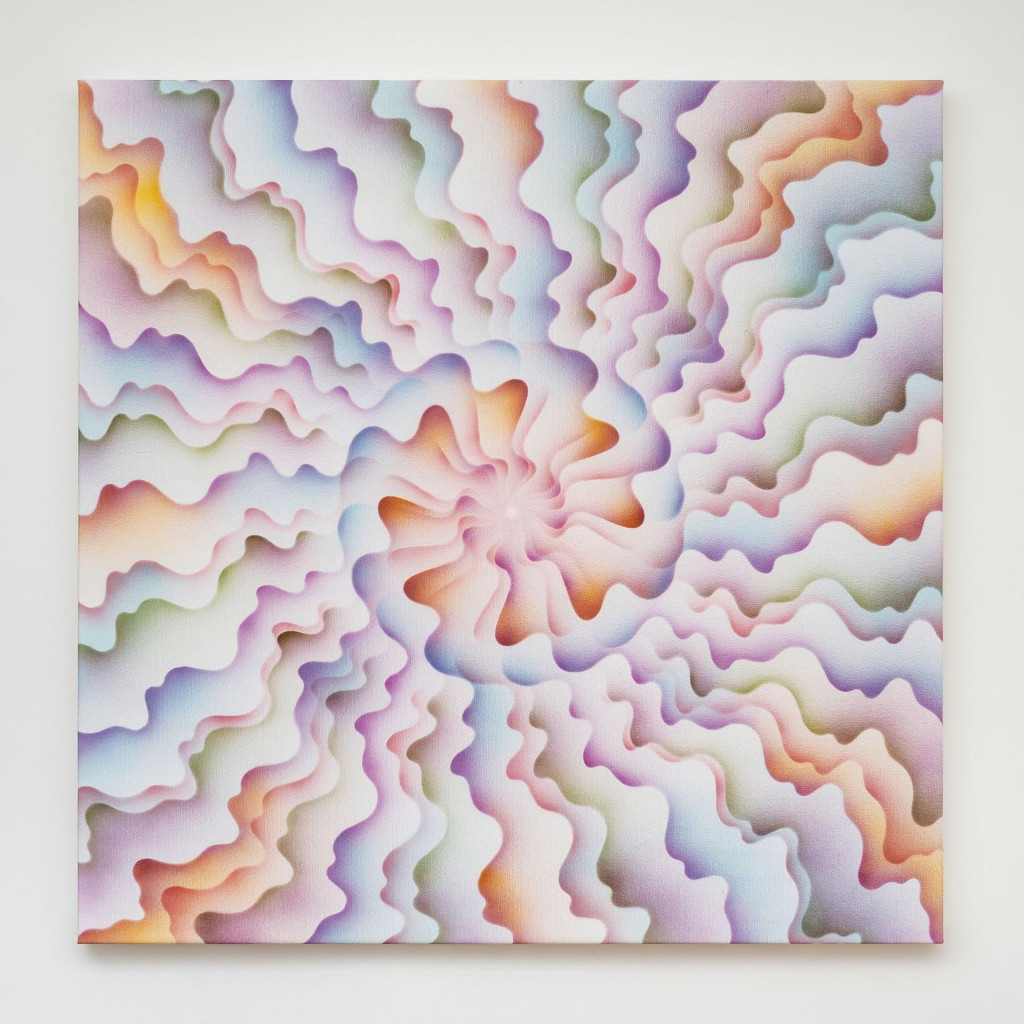
On the visual plane, paintings such as Owl’s Eye (2022) seem to pursue a similar goal. But here it is not an expression of desire for an immortal life. Paintings of eternity must survive in time, like the rest of us. As such, we encounter a mediation of the tensions between a symbol of fathomless form—the medial disc, suspended centrally—and the wave-lines, the tides, of time. We can think of them as the near symmetries of evanescent tides, or the geological stratifications that document ages, but too literal a reading of these works as representing nature—and not our perception of nature—leads us astray.
A compelling religiosity plays out in many paintings in the series, without ever articulating a tangible spiritual message. In paintings such as Shark Tooth (2022), wave- like forms weave at varying degrees of oscillation like an acid-tripping dancer, careering at full tilt away from a small but intensely powerful white circle. This universal sign often represents the cyclical nature of the universe, and here implies–but never wholly designates–an image of the sun or the head of a halo-adorned prophet. In this way, Ruscha’s compositions often have surprising formal precursors.
In El Greco’s Pentecost (c. 1600), marking the fiftieth day after Christ’s crucifixion when the Holy Spirit descends upon the Apostles, an extraordinary verticality is created by the taut torsos of the sky-facing saints, whose ranging bodies coalesce with an upward-directed stream of pigment to the flaxen light-source of the sun, or heaven, as a white dove emerges. In Ascension (2022), that same devotional energy is conjured in the formal arrangement. The title, too, recalls the ascent of Christ into heaven on the fortieth day after the Resurrection, ten days before the event of El Greco’s masterpiece. The entire direction of the painting is cast upwards and into the summoning vortex of emanating light and to the ultimate symbol of boundlessness. It sings. But here there are no saints, there is no symbol of peace—only the curvilinear geometries of nature at their most surreal and psychedelic.
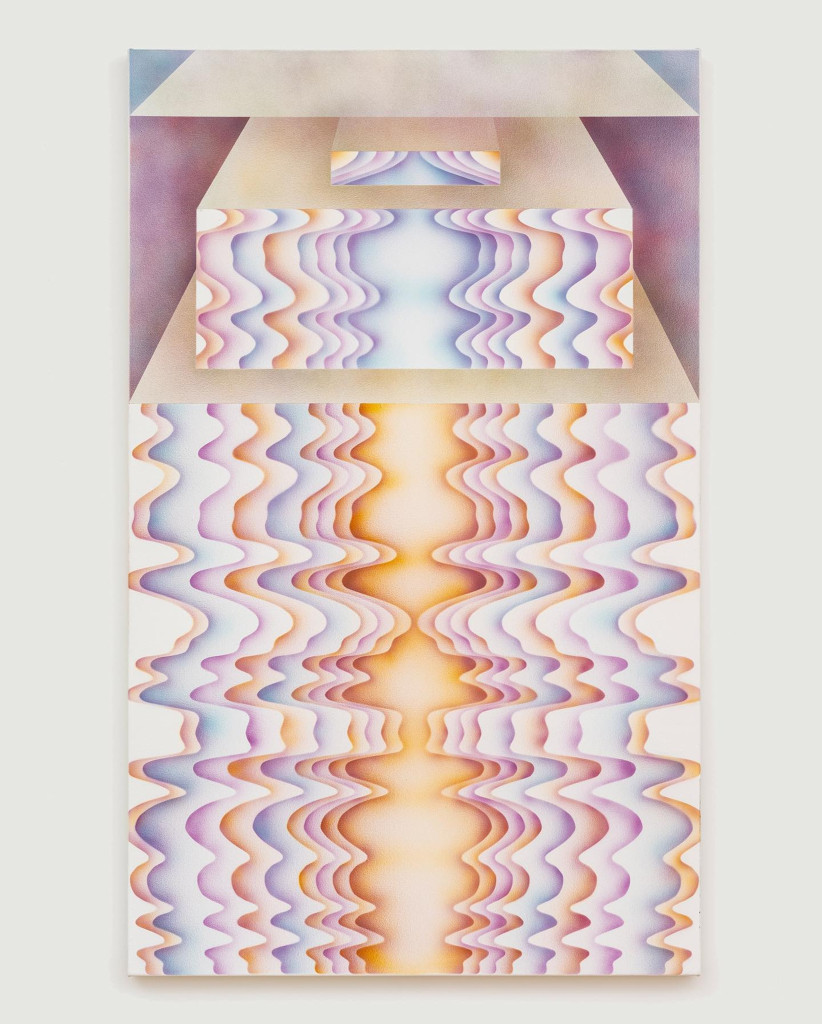
Many of Ruscha’s canvases experiment with various framing devices that accent juxtapositions between line, from, and colour, and in doing so call attention to their convoluted design and internal logic. Suspended II (2022) depicts a composition within a composition, as a square containing gradated teal and purple is positioned within the flutter of a washed-out red paint, like a pure stream that has hardened into the face of dusty desert sand. Looking closer, we realise that the wave lines between the two fields of vision perfectly touch despite being so unalike in colour and shape, as they extend beyond and are transformed by the thin white border that embraces the more frenetic, crowded interior plane. Suspended II is an experiment in painterly motion, and its title and visual organisation engage with a dialectical back-and-forth in a precarious space. By taking snapshots of extreme closeups of sound waves on a computer music program, Ruscha was able to prepare the varying complexities of wave; broadly speaking, the larger and smoother the individual wave, the lower the tone. As each wave surges from a gentle white to pulsating colour, we imagine each one in a kind of clockwork motion but in divergent directions, all gyrating from the central orb in the distance. Time as well as space cannot be taken for granted.
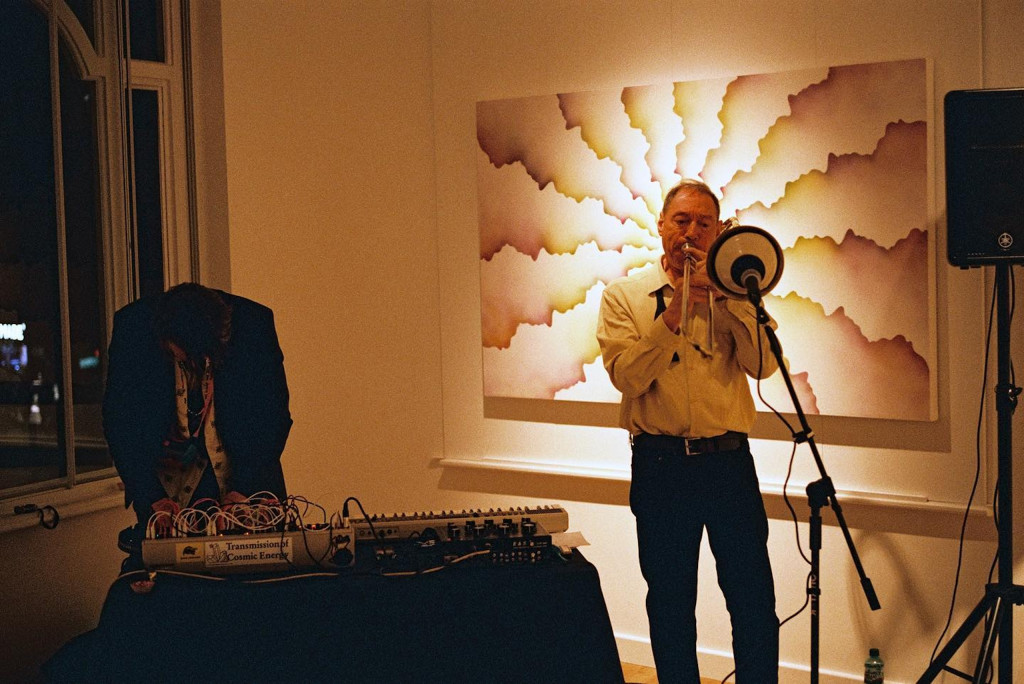
In some ways, we can read Ruscha’s paintings as the spatialisation of sound. ‘I feel as though visual psychedelia crosses into music like adding reverb or echo or phaser to a sound’, Ruscha reflected to me: ‘It forces the sound out of its place into another kind of space’ (8). Whether we are in the prehistoric cave, beatboxing on the neon boulevards of L.A., or lost in one of the spatial domains revealed to Aldous Huxley, high on LSD on Mulholland Highway that in turn inspired some of the most original writing on sensory perception in the twentieth-century, we see the ways in which the making of the work, the experience of performing making, is where meaning can be held. ‘In the end it’s all about learning and making records of the process’, explains Ruscha, emphasising the spontaneity as well as restraint in his practice: ‘It’s like when Thelonious Monk said: “you rehearse every time you play on your instrument” (9). These paintings also seem to channel the spirit of another moment in L.A.’s rich optical and musical history: the Pre-Code era, and the geometric choreography of Busby Berkeley’s black-and- white musicals of the early 1930s. In these kaleidoscopic dances, such as the rip-roaring Footlight Parade (1933), bodies are seen from above as they spin and gyrate in centripetaland centrifugal motion, accompanied by a thrilling musical accompaniment. Formations are made, disbanded, and remade, as they resemble exotic flowers or the constellations of stars in blinding close-up. They look like a monochrome Ruscha canvas in celluloid motion.
While the movement in these paintings is so often given as rotating in a circular fashion, we necessarily found ourselves in absolute relation to it. In much the same way that we might describe the rectilinear energy of a Mark Rothko painting as an invitation, even a command, to inhabit its space, Ruscha’s perambulating acrylics seem to call us forth into its arena of ovoids and vibrating waves. That they represent space in time, however transformed. Standing in front of Klipsch (2022), a painting named after the horn speaker, you can see a perplexing and powerful circle, as though the emanating energy of a light-source hovering in the middle distance: the suggestion of a sun on the horizon line of another world. Vincent van Gogh painted Olive Trees With Yellow Sky And Sun (1889) while in the asylum in Saint-Rémy. In this painting, an irregular undulation of gradated pigment flows to the earth, the trees, the sun, and the sky. The same horizon line is both a sun and a ball of paint, a reference to a world beyond our perception.
More than anything else, both Van Gogh and Ruscha remind us that it is the painter’s task not to represent the world as it is, but as it is seen. It is a crucial distinction. These dimensions of colour create, of itself and for itself, a materiality, a something. As the philosopher Maurice-Merleau-Ponty writes, on Cézanne: ‘space, of which one would suppose that is self-evidence itself and that for it at least the question of where does not arise, space itself radiates about planes which we cannot assign to any place’ (10). We might not be able to assign a concrete place to Ruscha’s paintings, but they represent some of the most profound painterly confrontations with the nature of phenomenal space on either side of the valley.
Exhibition catalogue essay by Matthew Holman
1 – See Mike Davis and John Weiner, Set the Night on Fire: L.A. in the Sixties (London: Verson, 2021).
2 – Paul Cézanne, referenced in Maurice Merleau-Ponty, ‘Eye and Mind’, in The Primacy of Perception and Other Essays, ed. Jams M. Edie (Evanston: Northwestern University Press, 1964), p. 180.
3 – See also the extraordinary LP cover of Thinking A View, Ruscha’s collaboration with Peter Zummo, that accompanies the exhibition.
4 – Amédée Ozenfant, in Foundations of Modern Art, 1924.
5 – Some doubt the authenticity of this remark. See Paul Bahn, ‘A Lot of Bull? Pablo Picasso and Ice Age Cave Art’, Munibe. Antropología y arqueología 57, no. 3 (2005–6), pp. 217–23.
6 – Eddie Ruscha, interview with the author, 12 September 2022.
7 – Ibid.
8 – Ibid.
9 – Ibid.
10 – Maurice Merleau-Ponty, referenced in Marjorie Grene, ‘The Aesthetic Dialogue of Sartre and Merleau-Ponty’, The Merleau-Ponty Aesthetics Reader: Philosophy and Painting, ed. Galen A. Johnson (Evanston: Northwestern University Press, 1993), p. 221.