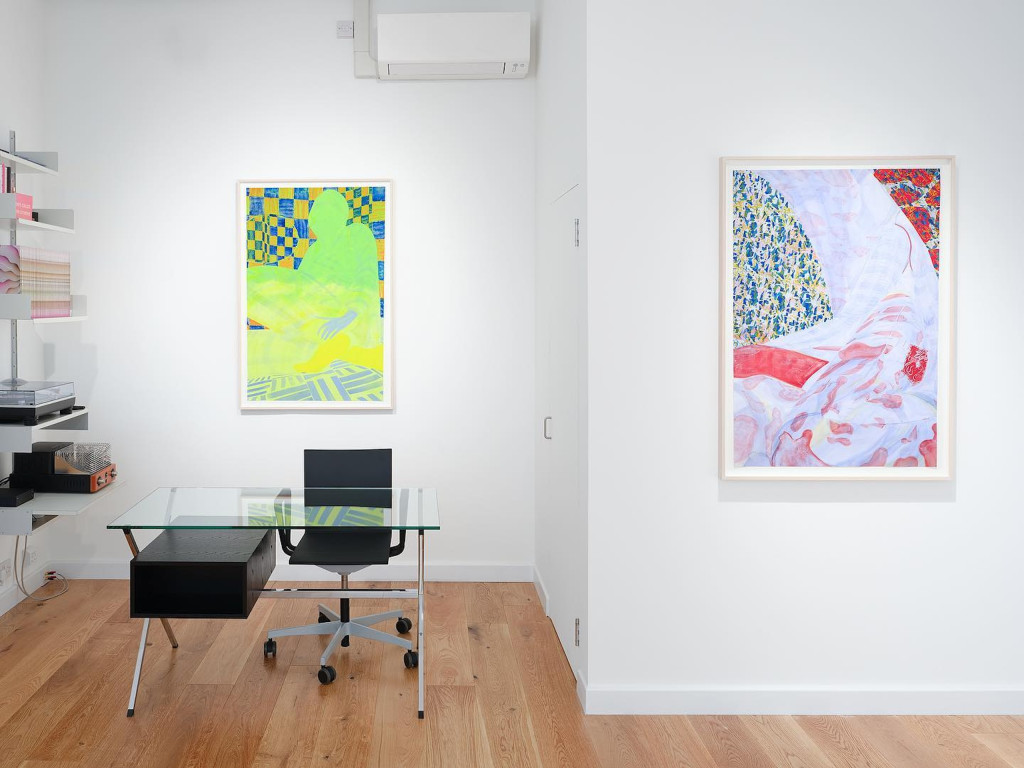
A duo exhibition of new works by Beatrice Lettice Boyle and Hannah Tilson.
If you would like a catalogue of the works, please email: cedric@cedricbardawil.com
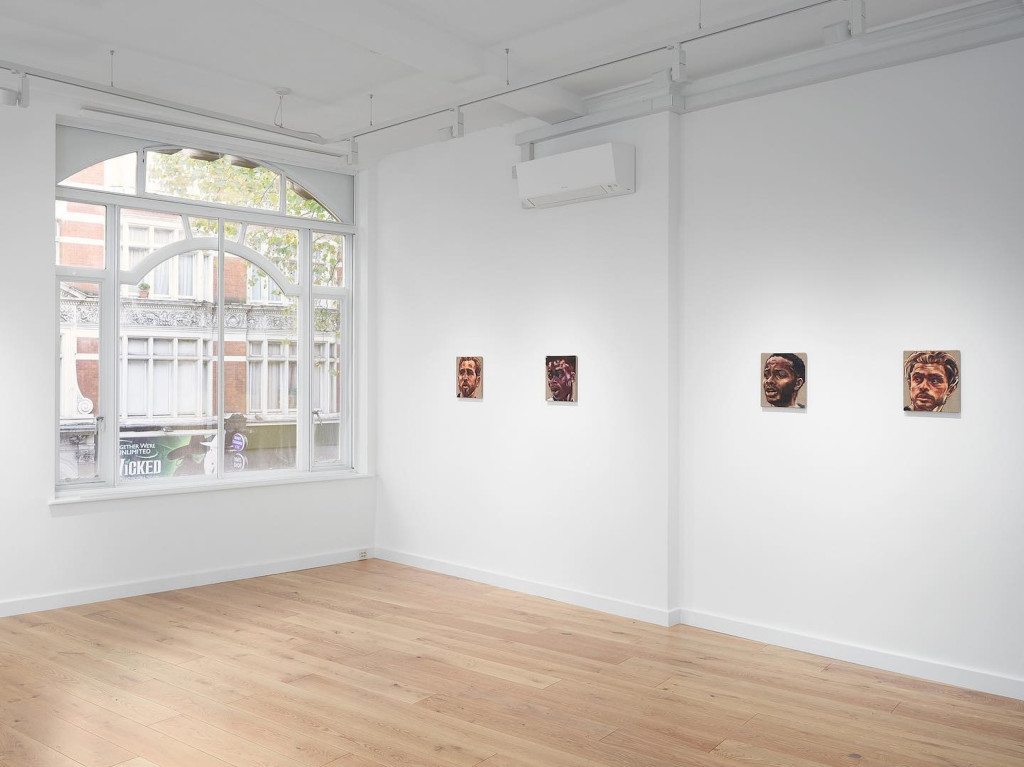
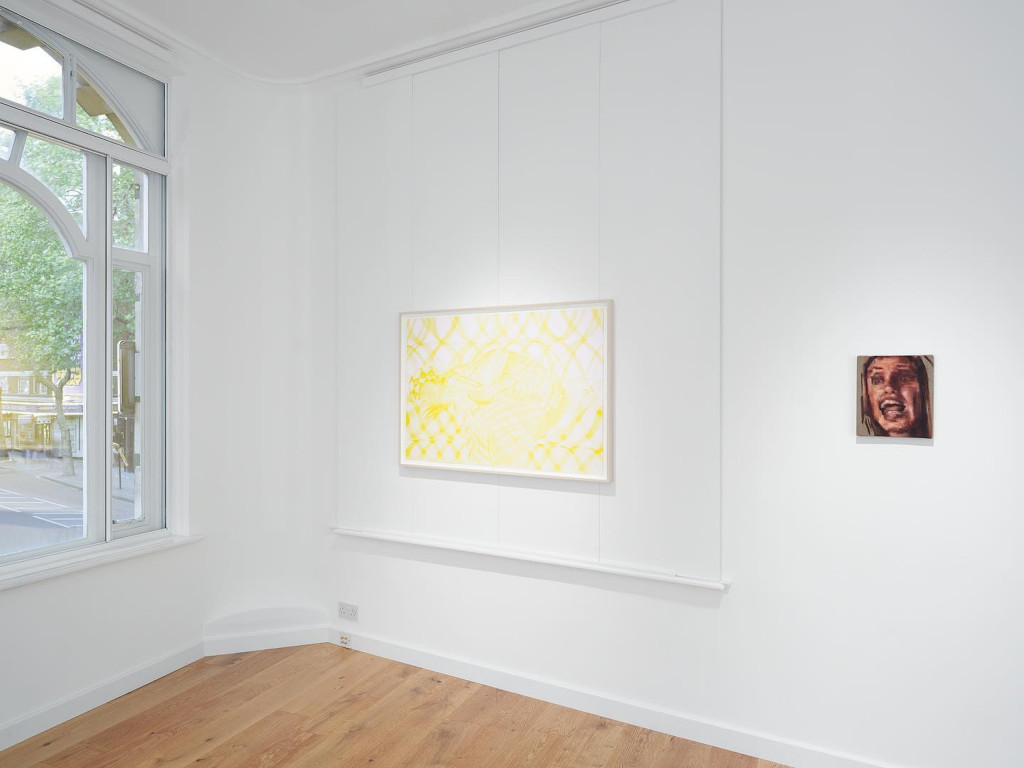
In July last year, England and Italy battled it out in The UEFA Euro 2020 Final, a football match at Wembley Stadium in London. The game finished with a draw resulting in a penalty shoot- out which saw Italy win their second European Championship, the first taking place in Rome against Yugoslavia in 1968. London-based painter Beatrice Lettice Boyle was taken aback by the heightened feelings surrounding England’s loss, which inspired her to incorporate football into her work. “Everyone was heartbroken and crying in public,” she says of watching the match in an English pub. “It is often a majority male macho space where you wouldn’t normally talk about your feelings or be visibly emotional,” she adds. “The fact that that’s transformed during the football to a place where people were crying and being open is a big element in my paintings.”
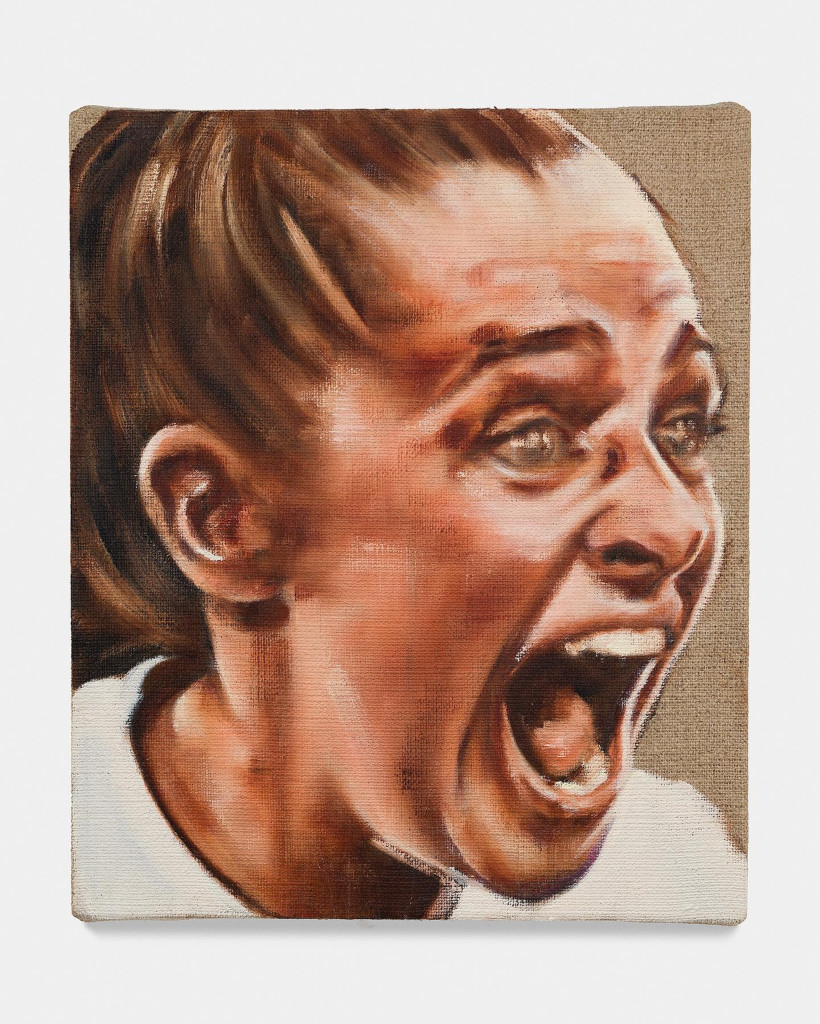
Boyle has been painting tightly cropped portraits of footballers since the 2020 championship, many of which feature in A Flash of Blue at Cedric Bardawil. These works are shown alongside self-portraits by the also London- based artist Hannah Tilson. Both Tilson and Boyle have repetitive themes and motifs that tie their recent work together. Boyle focuses on the heightened emotions of her subjects. These are mainly footballers, though, the American Actress Shelley Duvall, known for playing eccentric characters and who was a protagonist in Stanley Kubrick’s The Shining, has also been the focus of many pieces. “I find faces most compelling to paint (and also to look at) because someone’s facial expression, especially when it’s cropped so there’s no context, can describe so much or allow you to project onto it,” Boyle says.
Both artists are more interested in allowing the viewer to make their minds up about the ideas behind their work than making it clear themselves. Tilson does this by giving little of herself away in the collection of self-portraits in the show. “I want [viewers] to be able to see themselves in it,” says Tilson. Boyle does the exact opposite by offering a purge of emotions of the people she depicts. “When I started painting the footballers, people called them tender or heartbreaking,” Boyle says. She believes that “the more evocative the expression, the more people can project and read into it.”
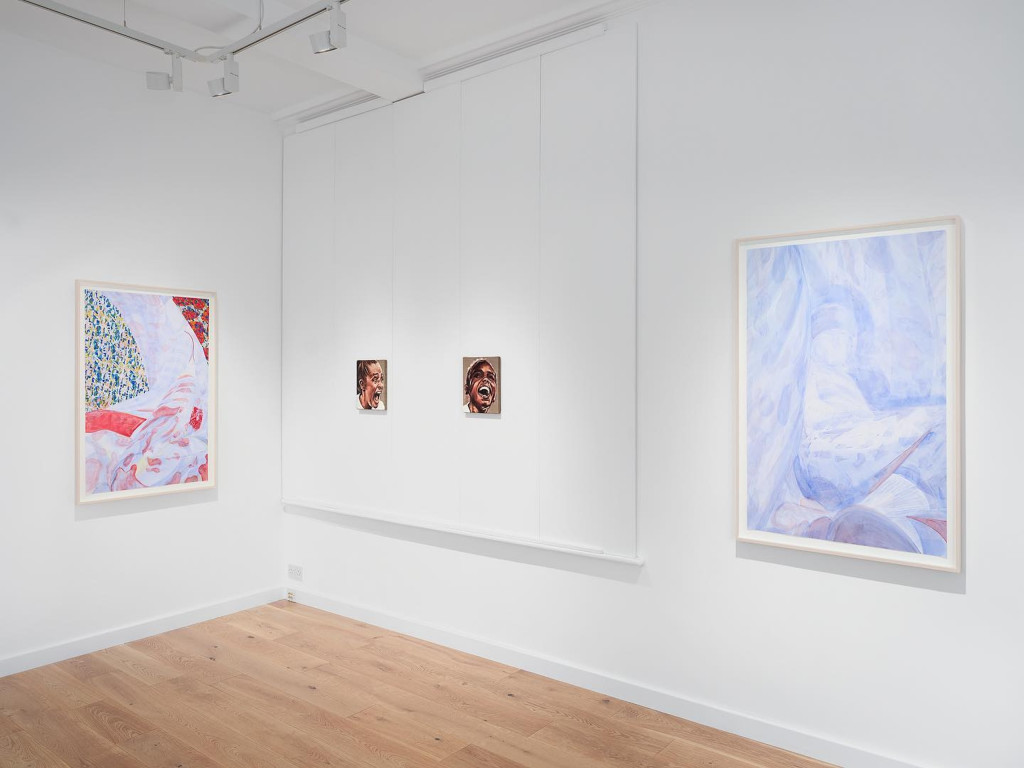
In contrast to Boyle’s portraits, Tilson reveals a much more significant portion of the subject in her paintings, though she has also staged them in a manner that creates a sense of obscurity. The person she illustrates (which she says is herself) is indiscernible in each painting in the show— an intentional part of Tilson’s current practice. “I want them to be ambiguous, but there’s still something within them for the viewer to hold onto,” Tilson says. “You might not see a figure in it until you see a knee or bum.” Soft Cut (2022) is a self-portrait which exemplifies this. In the piece, she appears to be sitting in an unidentifiable position, and only part of her arm and leg are recognisable. “I forced myself to stop at a point that I was uncomfortable with,”she says, noting that most people cannot even see that it depicts a person. “I could have easily added more of a face or more of a hand, but I like the fact that the angle of the figure looks so not believable.” A red trouser pocket is the most noticeable part of the piece, which consequently works as a marker for the fact this is a portrait of a human being for those who may not realise it at first glance.
Tilson first started making self-portraits in this way during the pandemic to explore her love of expressing herself through patterns and clothes. “In the first lockdown, I started drawing myself in these stage sets,” she says. She’d hang fabrics on the walls and dress in a manner that “camouflaged into the backdrop,” filming herself moving around in the space she had made and working from that footage. “It was a time where everything was super out of control, and being able to draw an image of myself helped me feel like I was in control of something.” Consequently, Tilson’s work evokes a sense of isolation even in pieces made after the pandemic, which she admits is unintentional. Limbo (2022) was created in September of this year at the artist residency Palazzo Monti in Italy rather than in lockdown. “I had a great time there, and it was beautiful. I had nothing I could complain about, but this work feels quite sad,” she says.
Meanwhile, Boyle’s paintings are not of her but are connected to recent melancholic feelings. The Euros in 2020 came six months after the death of Boyle’s father, which plays a significant role in her work. She believes British people embrace sorrow surrounding sport but often disregard or are uncomfortable with intense everyday emotions, such as grief. When England lost last year, she says she was “sobbing uncontrollably.” While to others, it may have appeared as if she was crying about the game, in reality, these tears were also about losing her father.
Boyle’s paintings represent this heartache. That said, only some of the characters appear to be showing the sentiments you would associate with this. “They represent grief to me, but there are all these layers to it, and some of them are completely hidden, and some are more explicit,” Boyle says of her football paintings. In NIKITA I (2022), the 28-year-old English footballer Nikita Josephine Parris seems to be laughing, but in ELLA I (2022), it is difficult to decipher whether the subject is screaming or crying. Boyle portrays the 23-year-old Manchester United W.F.C. forward Ella Toone in a moment of heightened emotion. For those knowledgeable about the sport, the image appears to depict Toone after she scored a goal for England during the Euros this year. Her team won the championship with this particular match. In Boyle’s portrait, Toone’s mouth is wide open as if she is yelling. The crop is so tight that, without the information of where or when this could be or who the person is, there are very few direct indicators of what exactly the person is supposed to be feeling.
Tilson and Boyle demonstrate that there are many ways to render the complex emotions that come with human experiences using portraiture. For Tilson, this comes in the form of subtly and vagueness, while for Boyle, it is about presenting a moment of intense passion. “Both are open to interpretation, or you can project onto them even if you don’t know who they are,” Boyle says. “I think that will be really interesting when the works are alongside one another.”
Exhibition catalogue essay by Precious Adesina