If you would like to request an exhibition catalogue, please email: cedric@cedricbardawil.com
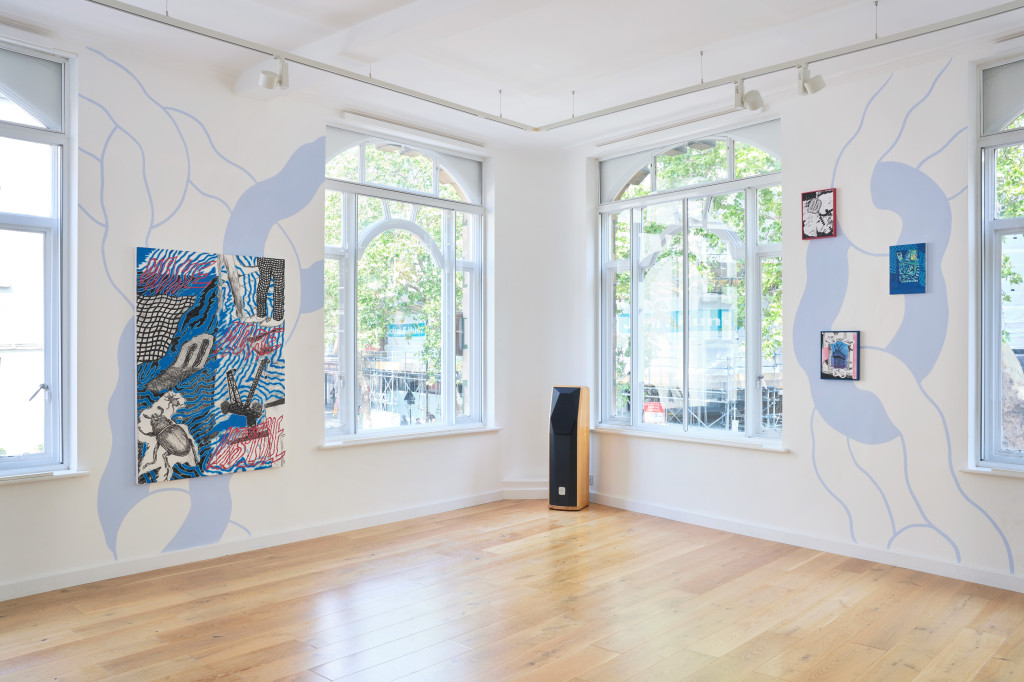
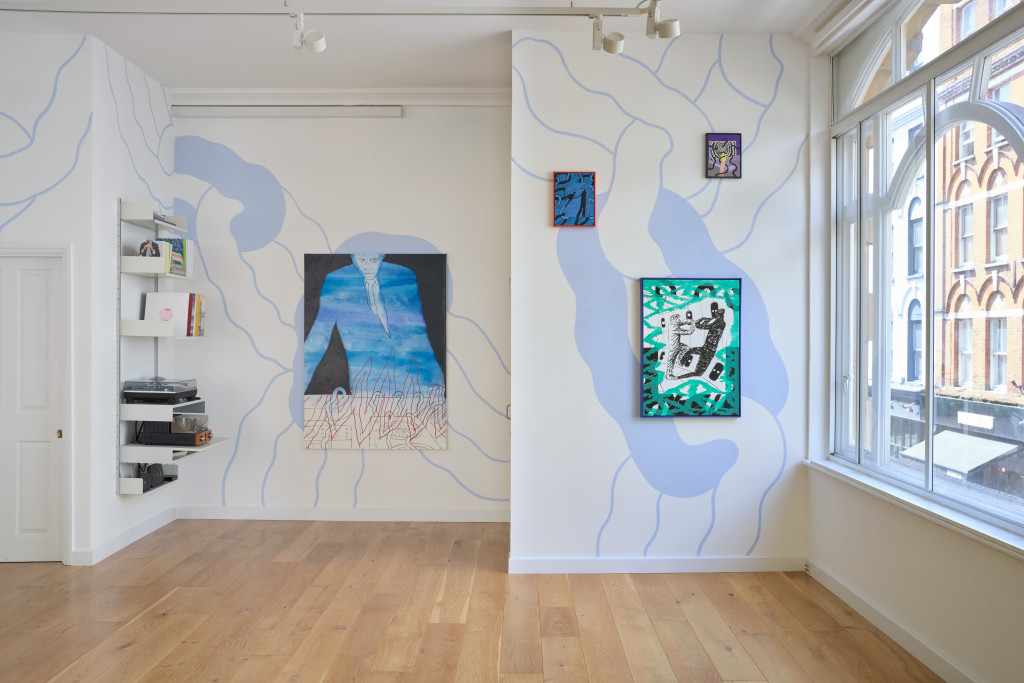
Make More Visible is Adam Shield’s debut solo exhibition with the gallery.
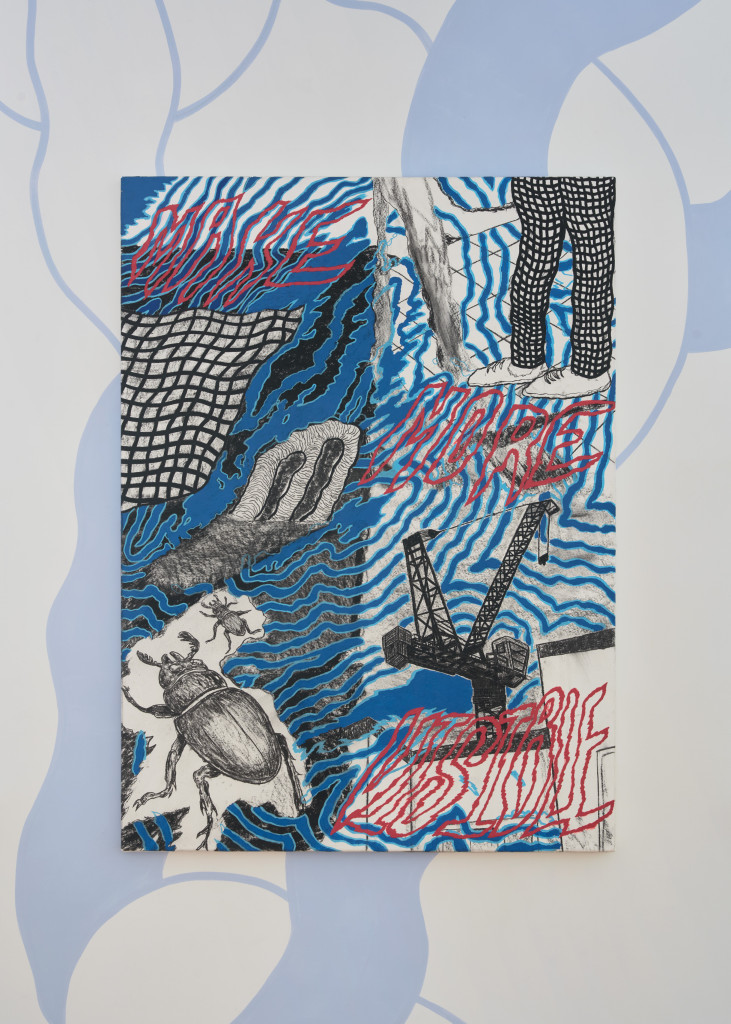
“What does it mean to make something more visible? Does it mean recovering something unseen, buried like a palimpsest in an archaeological site, or graffito surfacing on an inner-city wall? Or does it mean giving form to something latent, drawing into view what had no shape before? And what work is the word ‘more’ doing here, as though some objects were less visible, even less real, than others? With its collagist build-up of figurative references, abstract patterning, and graphic text, the title painting of Adam Shield’s present exhibition asks these questions without ever steering us to the safety of certitude.”
— Matthew Holman.
Adam Shield
Make More Visible
Essay by Matthew Holman
‘A work of art is not a thing but a way of looking at things. It is a method of expressing how you see the world. The creation itself is secondary to the vision behind it. What matters is not just the physical manifestation of art, but the perspective and insight that it brings to those who encounter it.’
– Gertrude Stein
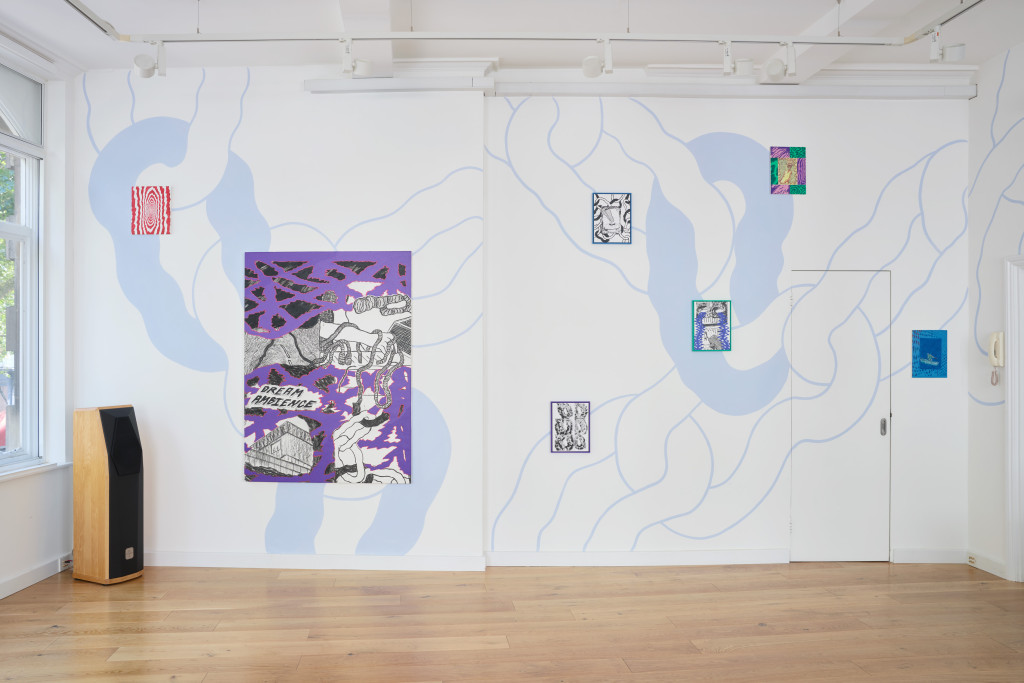
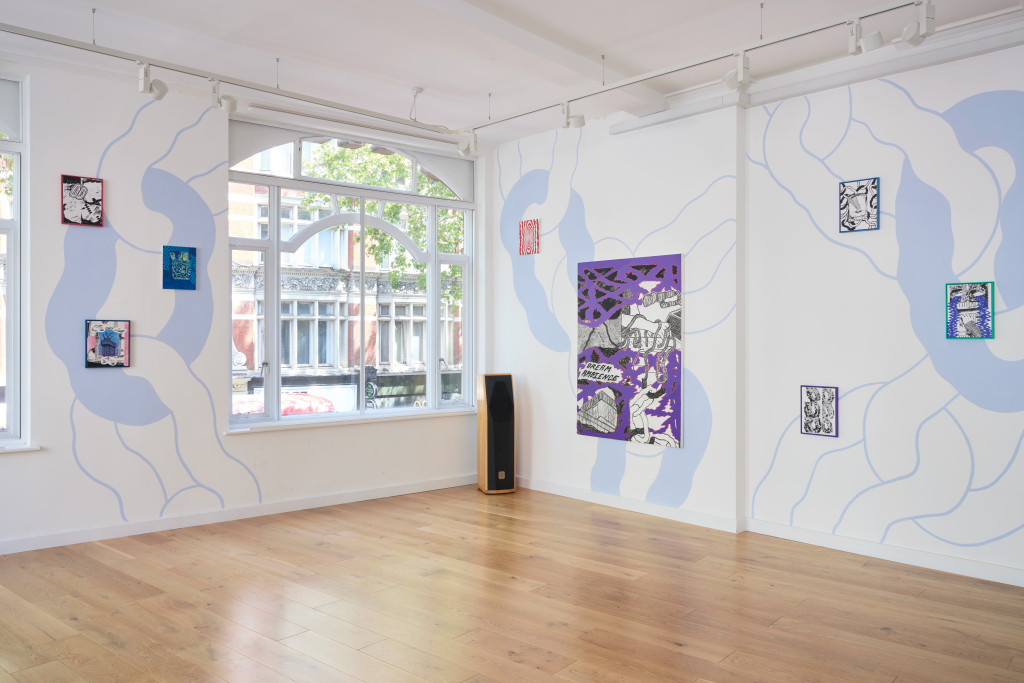
What does it mean to make something more visible? Does it mean recovering something unseen, buried like a palimpsest in an archaeological site, or graffito surfacing on an inner-city wall? Or does it mean giving form to something latent, drawing into view what had no shape before? And what work is the word ‘more’ doing here, as though some objects were less visible, even less real, than others? With its collagist build-up of figurative references, abstract patterning, and graphic text, the title painting of Adam Shield’s present exhibition asks these questions without ever steering us to the safety of certitude. The three words of the title are lettered across the canvas in pink outline, scattered to separate corners and then half-dissolved into a field of rippling blue-and-white line, the kind of dazzle that pulls the eye out of focus as soon we allow it to settle. The imperative is there to be read and works against being read. A painting called Make More Visible withholds its own title from you, letting the optical field swallow the words we are apparently asked to see. Everything else feels like it is being seen through a glitching digital screen or a kaleidoscopic lens designed to make seeing difficult, as the objects reveal and hide themselves for our pleasure, and our frustration. A tower crane rises through the centre, the developer’s impersonal machine that is a recurring motif of Shield’s work, half-camouflaged in the rippling ground. Top left, the black diamond mesh of the hoarding appears as a patch of pure texture, while the black and white grid, like a vortex floor, a chess board, or a sound production controller, is an image of controlled space with no apparent purpose. A figure stands at the upper edge in gridded trousers and white trainers, cropped at the waist, present and faceless. Low in one corner a beetle is drawn with the attentive care of a naturalist’s fine-point pen, sharp where the lettering is smeared, as though Shield were testing how much attention each thing in the world is owed, and thus what value systems we place on looking and recognising. The painting, in short, sets its legibility against itself. The rest is up to us.
Land of Plenty (2025) oscillates linguistic and visual modes of recognition, although appears subsumed by a kind of melancholic atmosphere, more remote, with fewer objects to compete for our attention. A construction crane stands on a concrete core washed in pale blue and lilac watercolour, framed once again by the diamond mesh of site hoarding, the title hand-lettered across the panel in Shield’s loping script. The hoarding is the perfect Shield motif. It conceals the building work while advertising those abstract values (‘compassion’, ‘care’, or a new ‘synergetic neighbourhood’, blah blah) we are told are going in, or might be realised, but never see: the developer’s habit of hiding its machinery behind a printed promise of the world to come. The three collaged text ovals, like cumulus clouds above an electric storage unit, caption the image as ‘LAND OF PLENTY’. The disjunct is striking because whenever we close our eyes, whenever we reassure ourselves that we are the haves and not the have-nots, that we live in a sceptred isle of plenty, we might picture the immediate pleasures of the dinner party or the abundant organic grocer. We never picture the industries downstream from our comfort, not least because they are ugly but because, more importantly, we are so often estranged from the real economy and means of production. Not so by Shield’s studio on the Thames Path at Woolwich, downstream of the Barrier, that sewage outfall, the storm surge, the end of the world. This is the cold concrete on which our prosperity, such as it is, rests. The work speaks to Shield’s own sense of layering and reminds us of how much of the city that we encounter is a palimpsest of material function and reified value systems: ‘South London’, Shield says, ‘is always reforming and reconstituting itself, and the hoarding is the membrane that reformation hides behind.’
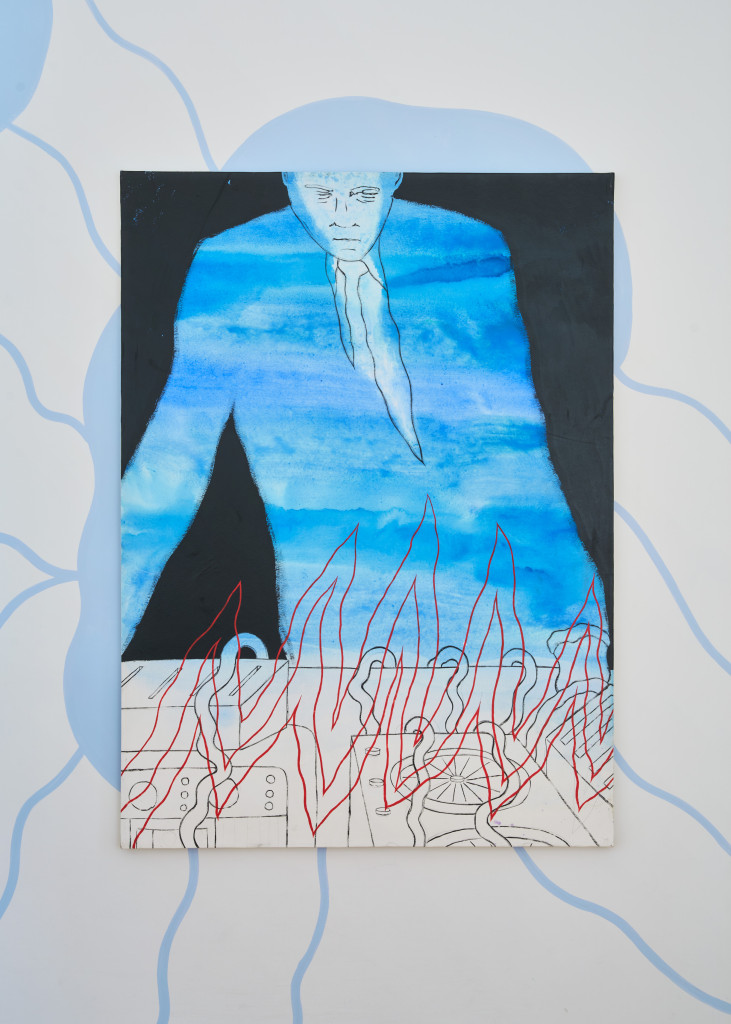
Dream Ambience (2026) takes Shield’s aesthetic of fractured visibility somewhere stranger. Against a bruised purple ground, a brutalist concrete building sits low in the frame, drawn in cold architectural line. It’s the corner of a foreboding police station near Edgware Road, closed after corrupt policing and later squatted, and for Shield thus a structure that looks just as it should – remote, cold, functional, austere – that wears its heart on its sleeve. Serpentine cables uncoil across the upper half of the painting, vascular and loose, the lines of power and surveillance pulled out of the wall and left to dangle like cut wires. I like to think that it might be the negative image of a city, a squatter’s paradise, dreaming about its own nervous system. Shield seeks out the unsettling adjacency of images that happens when you’re half asleep, as the real and the vaguely familiar imprecision of the unreal vie for space, like the collages of Zurich Dada. He draws small, dozens of fragments at a time, and recombines them until the source mutates past recognition. In this practice, he acknowledges a debt to Amy Sillman, who also constructs ebbs and flows of juxtaposing visual layers, allowing her expressive use of colour to create striking areas of sometimes recognizable forms, so much so that Sillman’s interest in ‘the motion between the known and an abstract (but felt) unknown’ feels resonant for Shield, too. He gives you enough to recognise, a building you could walk into and cables that seem identifiable as wiring, then lets the bruised purple field swallow the edges until you are no longer sure what you are looking at. The painting lives in that slippage, as the labyrinth Shield keeps returning to remains a phantasmagoria that one moves through without ever seeing or apprehending the whole.
His titles cluster around openings and absences, unpleasant apertures to unreal landscapes. Worm Hole, Portal, Local Void, Retinal Instrument: a vocabulary of passage and looking, the eye hunting for a device that lets it see through. Flood Drill (2026) features rounded-rectangles on a modular wall, with two circles like Eckleburgian eyes, while two charcoal figures – perhaps a man, with bagged feet, and his shadow – grapple at the centre of a turquoise field, wrestling or holding on, ringed by those capsule-shapes with retinas that watch the struggle without intervening. The grid floor tilts beneath them. It feels like a painting about being braced for a disaster that hasn’t yet arrived, the civic rehearsal of catastrophe that gives the work its name (and also lends its name to a text Shield wrote across 2025, a fictional walk along the Thames Path first shown at TACO! in his exhibition of the same title). Can we prepare for catastrophe like we might choreograph a dance routine, or memorise the partnered clap-and-chants of children? Can we make ready for the end times with our shadow? The painting knows the honest answer is no. The water comes whatever steps you have learned, and the capsule eyes keep their distance, watching the way a camera watches. Shield leaves his figure the only partner a flood allows, the dark double dragged out of his own outline, and lets the two of them hold on.
The perseverance of lonely figures is a recurring theme in the works. In FLUD I (2026), made with paper on ink and acrylic on panel, a lone figure paddles a canoe along the Thames, dwarfed by the slab of the Tate building behind him, a single life measured against the scale of monolithic industries it drifts past. Shield was inspired by a clipping from a Yorkshire newspaper, depicting a man who had kitted himself out in full survival gear, a prepper who had finally found his crisis, and what remains is a harrowing picture of a reinvigorated mode of ancient travel through London in a not-too-distant future, its infrastructure overwhelmed by nature. The Thames Barrier presides over all these pictures while rarely appearing. It’s the largest hidden structure in Shield’s London, a machine built for a day everyone hopes never comes, and it stands behind the show as a reminder that the whole arrangement is one tide from failing. Elsewhere, in Cascade (2025), we see another figure seemingly haven fallen into an aqueous abyss, although here he falls between the cracks of the checked grids that we saw in Make More Visible. It looks a bit like an Escher picture, a grid leading to an end as definite and as impossible as a cliff edge, as the figure with his almost comically large hands falls flat into a no-go zone. These are absurdist rather than tragic pictures, pictures of human fragility when all the careful planning to protect oneself has been overwhelmed by the blunt instrument of reality.
It is difficult to separate Shield’s artistic and musical practices, as both rely on a certain degree of pre-gamed organisation, consistent patterning, and complex layering, while also relying on a degree of arbitrary intervention which changes, and is in turn changed by, the over girding formal logic of the piece as a whole. Shield builds music from a step sequencer, dropping samples into a pre-made grid and triggering them at fixed intervals, and the grid that orders his tracks is the same, I would determine, as the one that orders his city. London zones itself into blocks and plots, and Shield lays his images onto that matrix as if each were a sample waiting for its beat. A high-hat pattern chops the rhythm into a stutter while an ambient synth pad washes underneath; we might call it the wall painting’s equivalent in sound. A motif arrives, loops, and shifts a degree each time it returns, the way Shield’s images recur across the panels in slightly altered form. In this light, the grid carries a double charge: in the sequencer it’s time, divided and looped, but we might also find it as subject matter as well as form, because in the city it is the civic armature deciding where a tower goes and where the water is held back.
Most of Shield’s tracks begin with a field recording, made on the commute or the walk to the studio, the city carried back as a snapshot of a particular moment. He layers synth and fragments of guitar over these recordings and so the recordings localise the music, as though the city is locked in to a spiral of speaking back to itself, stranger this time, defamiliarized from its source. The siren on Bethnal Green, slowed until it works almost as an instrument, was caught on a lunch break from a gallery job nearby. Vortex began at a building site near Liverpool Street. On the title track, words by Sam Fischer, performed by Anna Hughes, give a fragmentary account of a self half-seen through an industrial waste ground, and the drum sounds and synths were tuned, Shield says, to feel electrically charged, like the signals the text describes. That charge is the link between what you hear and what you see. The blue signal-lines crawling across Make More Visible, for instance, are the synth pad made visual, one electrical sensibility working in two media. A field recording smuggles the actual sound of London into the studio the way the collaged drawing smuggles its actual structures into the frame, and in both the raw material gets processed until the document becomes something at once urban and ethereal, clearly bound up with the hard, deep materiality of the city but somehow existing in a fugue state. This is what it means, for Shield, to make something more visible: he gives the city back to you slowed down and half-camouflaged, the hidden machinery and the held-back water pressed against the surface of the picture, until looking itself becomes the subject. Gertrude Stein called a work of art a way of looking at things, and Shield’s way of looking settles on the ground we take for granted, one tide from giving way.